
On this page15 sections
- What is a water town?
- Qibao: a food street inside Shanghai, not a town
- Zhujiajiao: the easy day trip on the metro
- Jinxi: the quiet alternative for anyone disappointed once
- Tongli: worth the extra hour for its garden
- Xitang: only worth it after dark
- Nanxun: the silk-rich town few foreigners see
- Wuzhen: a resort, and beautiful anyway
- And three we took out
- Which water town should you pick?
- How do you get there without a tour bus?
- When to go, and three stretches to avoid
- How PoppaTrip schedules a water-town day
- A closer look at one town
- Questions about the water towns near Shanghai
Which water town near Shanghai should you visit? For a free evening, take metro line 9 to Qibao and eat. For an easy day trip, take line 17 to Zhujiajiao on a weekday morning. For quiet, go to Jinxi. For a night away, sleep in Xitang or inside the gate at Wuzhen. Skip Zhouzhuang, the famous one.
It is eight in the morning at Hongqiao, and the line 17 platform is doing something no other Shanghai metro platform does at that hour. It is relaxed. Nobody is running, and half the carriage is carrying a thermos. About fifteen minutes out the train comes above ground and the city simply stops. Towers, towers, towers, then flat green fields and water, all at once, as if someone had turned a page.
Fifty minutes later you are standing on a stone bridge built in 1571, over a canal with laundry strung across it. A man sculls a flat-bottomed boat under your feet. You got there for about eight yuan without booking anything. It is the best-value thing Shanghai has to offer, and most visitors do it wrong. There are about a dozen water towns near Shanghai, they are not remotely interchangeable, and the famous ones are not the good ones. Here are seven that survived checking, in order of effort, and three that did not.
What is a water town?
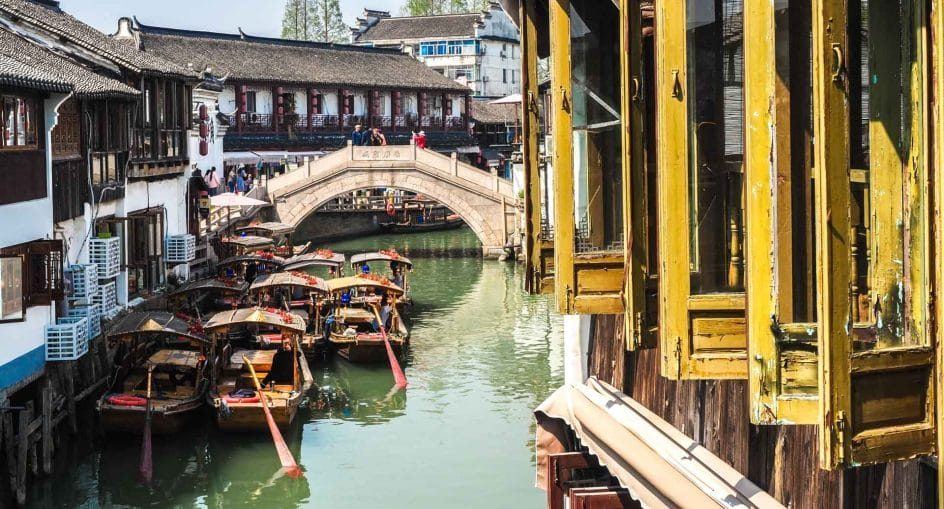
The Chinese term is a Jiangnan ancient town, and the type is specific. It is a settlement in the delta south of the Yangtze, built around canals rather than roads, where the water was the street. Goods moved by boat. Houses turned their backs to the lane and their front doors to the water, and stone arch bridges went up high enough for a laden barge to pass under.
Most of what you see is Ming and Qing. The word to be careful with is restored. Every town here has been repaired, and one of them, Wuzhen, was rebuilt to a standard that makes it a resort rather than a town. Treat them as interchangeable and you end up paying ¥150 for something you could have had free, forty minutes from your hotel.
Qibao: a food street inside Shanghai, not a town
- WhereMinhang, inside Shanghai
- Getting thereMetro line 9 (change at Xujiahui) to Qibao, then a five-minute walk. About 40 minutes from the center.
- TicketFree to walk in. A combined ticket for the small museums and halls is sold at the gate; you do not need it.
- VerdictHalf an evening, not a day trip
Start here, because starting here saves you a wasted Saturday. Qibao is inside Shanghai. It is forty minutes on line 9, it costs nothing to enter, and it is the only entry on this page you can do between lunch and dinner without rearranging anything.
What you get is one restored canal, two stone bridges, a temple, and a couple of hundred yards of covered snack street: crab-shell pastry, sticky rice cakes, sweet tofu pudding, candied fruit on sticks. On a Saturday afternoon it is shoulder-to-shoulder. On a Tuesday at six, with the lanterns on and the day trippers gone, it is lovely.
Call it what it is, though: a food street with a canal running through it. If you go expecting Tongli you will be disappointed within ten minutes. Go expecting dinner and you will have a very good time.
Zhujiajiao: the easy day trip on the metro
- WhereQingpu, western Shanghai
- Getting thereMetro line 17 from Hongqiao Railway Station to Zhujiajiao, about an hour and around ¥8. The station sits roughly 1.5 miles (2.5km) from the old town. Take the local bus or a short taxi rather than walking it.
- TicketFree to enter and wander. Individual halls and gardens charge separately, and a boat through the canals runs about ¥60.
- VerdictThe default day trip
This is the one almost everybody does, and for once the popular answer is the right one. Line 17 runs from Hongqiao out through the flat green edge of the city and puts you at the door of a real Ming and Qing canal town for the price of a coffee. There is no ticket gate. You walk in.
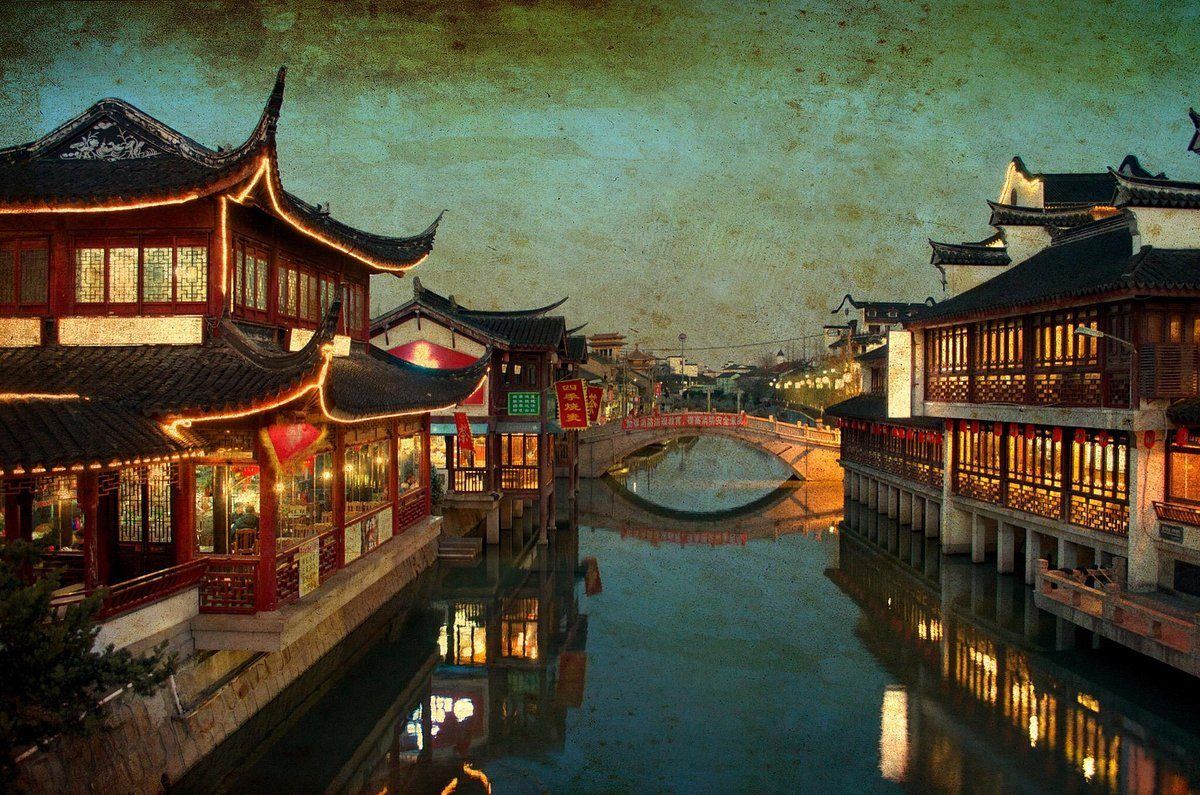
The thing to see is Fangsheng Bridge. It has five stone arches, went up in 1571, and is the largest bridge of its kind in the region. From the top, the town is whitewashed walls, black tile, laundry over the water and flat-bottomed boats sculling underneath. Behind the main lane the town keeps working. Someone shells beans on a step, a postal museum fills a Qing-dynasty post house, and Kezhi Garden at the north end stays small and quiet because almost nobody walks that far.
The catch is the weekend. Zhujiajiao on a Sunday in October is a slow-moving river of people, and the charm barely survives it. Go on a weekday, go before ten, and the same lanes are close to empty.
Jinxi: the quiet alternative for anyone disappointed once
- WhereKunshan, Jiangsu
- Getting thereMetro line 11 to Huaqiao and a local bus or taxi onward, or about 45 minutes by car from western Shanghai. It is roughly 5 miles (8km) from Zhouzhuang, so the two are easy to pair.
- TicketThe lanes are free to walk. A combined ticket for the museums is about ¥55; a rowed boat is about ¥150 for the boat, shared between up to six.
- VerdictDay trip, and the quiet one
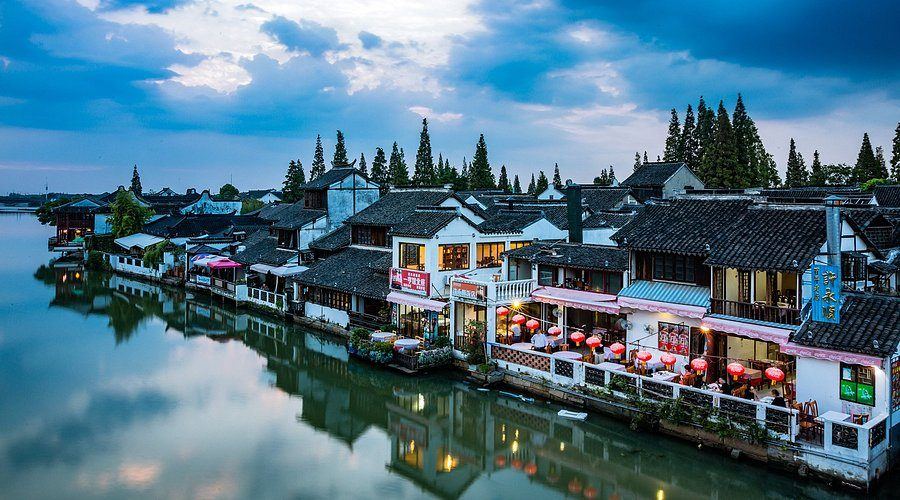
Jinxi is small and under-visited. It is the town people recommend to each other after they have been to a famous one and come home flat. It has the same ingredients as its neighbors (canals, arched bridges, a lake at the edge of town, Song-dynasty history layered under Ming and Qing houses) and roughly a tenth of the footfall.
It also has an oddity worth the trip on its own: a cluster of tiny, obsessive private museums along the water. Ancient bricks and tiles. Root carving. Chinese knots. Antique ceramics. They are exactly as niche as they sound and completely charming, and the ticket covers them all.
The trade is access: no metro to the door, so budget for a taxi on both ends. What you buy with the hassle is a canal town where you can hear the water.
Tongli: worth the extra hour for its garden
- WhereWujiang, Suzhou, Jiangsu
- Getting thereHigh-speed train to Suzhou, then Suzhou metro line 4 to its southern terminus at Tongli and the shuttle bus. The ticket counter at the metro station sells a combined bus-and-entry ticket. Around two hours door to door.
- TicketAbout ¥100 for a combined ticket covering roughly ten sites including Tuisi Garden. A separate evening ticket for the garden, about ¥50, covers roughly 6:45 to 8:30 p.m.
- VerdictLong day trip, better as an overnight
Every town on this list has canals and bridges. Tongli also has a UNESCO-listed classical garden, and that is the reason to spend the extra hour getting there. Tuisi Garden was built in the 1880s by a dismissed official. The name translates roughly as the garden of retreat and reflection, which is a wonderfully passive-aggressive thing to call your house. It is laid out to be read from a boat-shaped hall along the water rather than walked around.
The town is bigger than Jinxi or Zhujiajiao and takes real hours. It has forty-nine stone bridges and several preserved merchant residences. Locals cross the Three Bridges in a set order for luck at weddings. One former residence hides a study behind a cupboard, and there are enough tea houses on the water to sit out a downpour.
If you can, stay. In the evening the garden is lit, the day trippers are gone, and the canals turn black and reflecting. It is a different town from Tongli at two in the afternoon, and the guesthouses inside the old quarter are cheap.
Xitang: only worth it after dark
- WhereJiashan, Zhejiang
- Getting thereHigh-speed train to Jiashan South (about half an hour), then the K222 bus for a couple of yuan or a taxi for ¥50–70. Or, slowly and cheaply: metro line 17 to Zhujiajiao and a cross-boundary bus for about ¥5.
- TicketAbout ¥95 for a two-day combined ticket covering eleven sites; an evening-only ticket is about ¥60. Outside ticketed hours (early morning, and evenings on weekdays) the main streets are open and free, with the small attractions shut.
- VerdictStay the night. This is the overnight one.
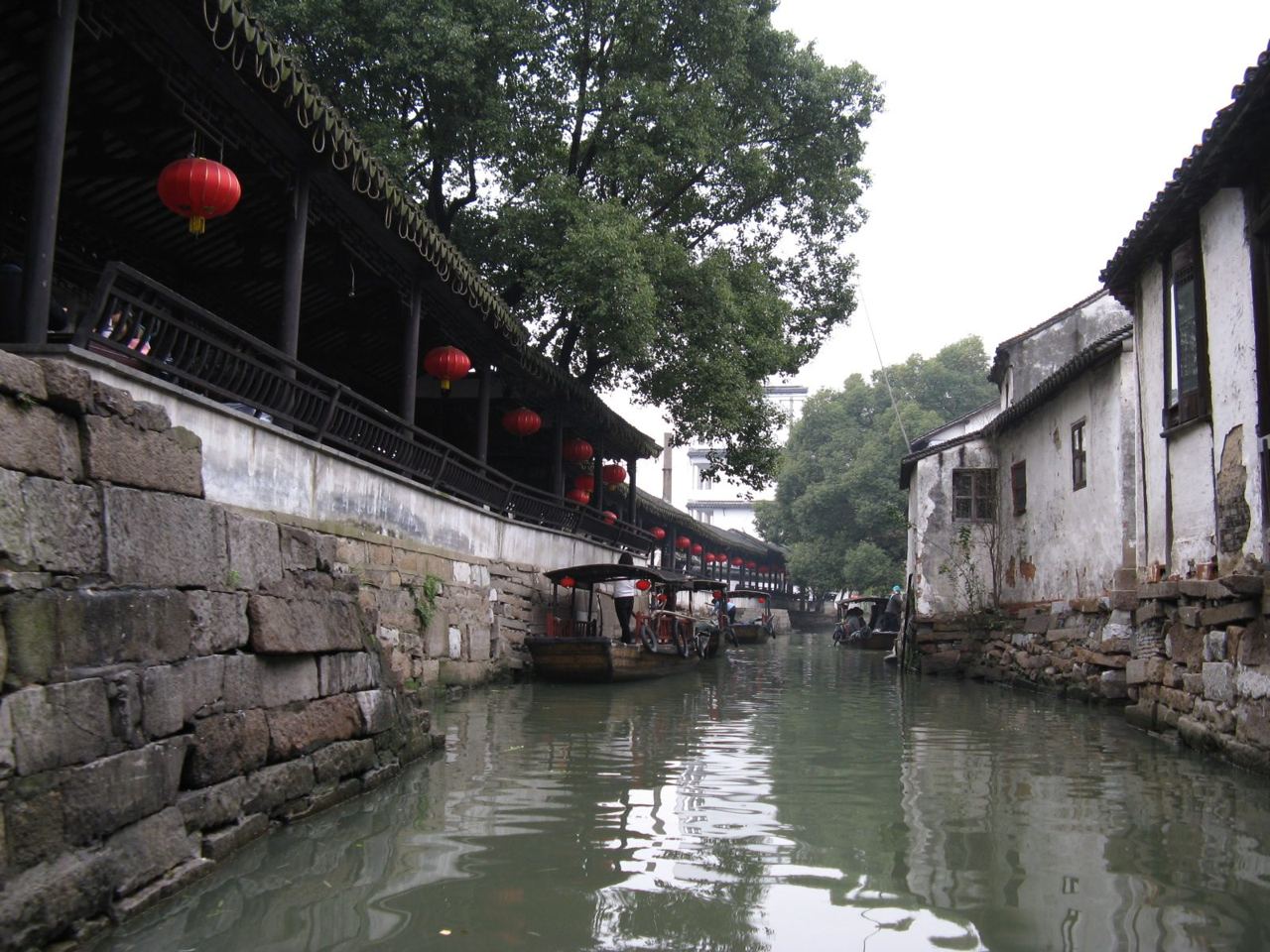
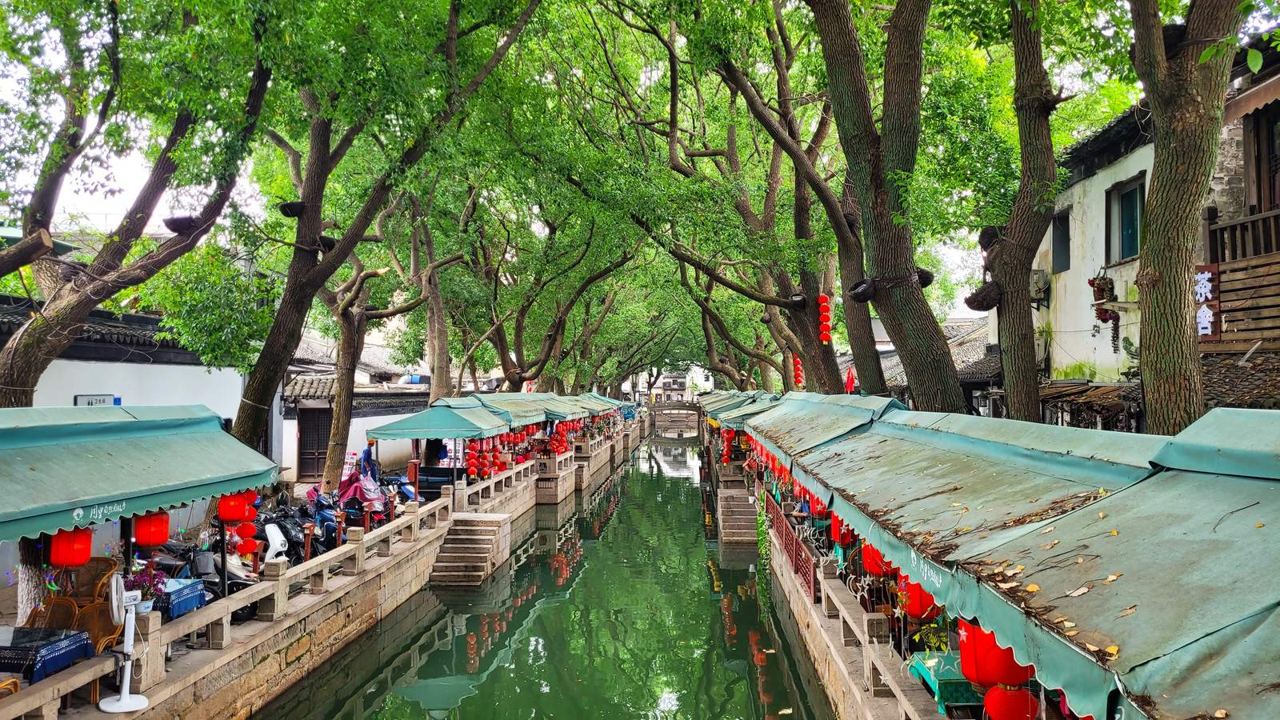
Xitang's whole case rests on one feature: over half a mile (more than a kilometer) of covered walkway along the canals. It is wooden-roofed and lantern-hung, built so that traders could work the water in the rain. It is called the langpeng, and it makes Xitang the one town here that improves in bad weather. It is also why every third photograph of a Chinese water town you have ever seen was taken here.
During the day it is a busy ticketed attraction, and it is fine rather than special. The town turns at about seven in the evening. The tour buses leave, the lanterns come on under the arcade, and the reflections turn the canal into a second town upside down. Some alleys are too narrow for two people to pass. Shipi Lane runs about 75 yards (68 meters) and narrows to about two and a half feet (80 centimeters). Lanes like it are unwalkable at noon and perfect at nine.
So sleep there. Guesthouses inside the scenic zone are plentiful, and staying changes the whole deal. You get the empty morning as well as the lit evening, and the day-trip crowd becomes something that happens while you are having lunch.
Nanxun: the silk-rich town few foreigners see
- WhereHuzhou, Zhejiang
- Getting thereHigh-speed train from Hongqiao to Huzhou Nanxun, about 43 minutes on the Shanghai–Suzhou–Huzhou line that opened in December 2024. The station is about 4 miles (7km) from the old town: a taxi is roughly ¥13 and 15–20 minutes, or bus 170 to its last stop and a short walk. Around an hour and a quarter door to door.
- TicketAbout ¥100 for a combined ticket covering six major houses and gardens, including Xiaolianzhuang and the Jiaye Library. Individual sites can be bought separately for ¥20–25.
- VerdictLong day trip; an overnight is no hardship
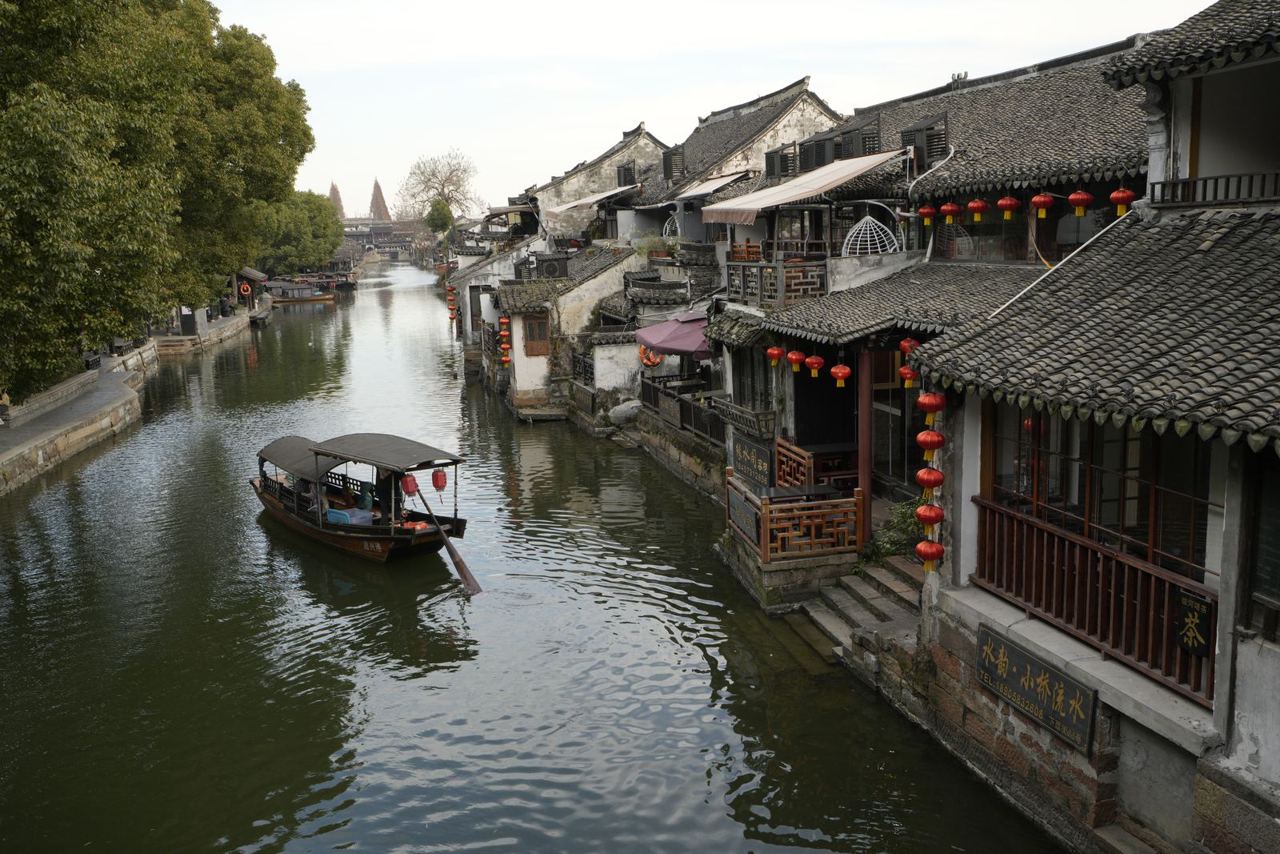
Nanxun is the outlier, and silk is why. In the nineteenth century this town's merchants sold raw silk into the Shanghai export trade, came home extraordinarily wealthy, and spent it on buildings. So the canals here are a supporting act. The main event is a run of enormous private compounds where Chinese courtyard architecture collides head-on with imported European taste. Picture a red-brick, French-windowed ballroom behind a classical Chinese garden wall, colored glass from Belgium, and carved beams and marble in the same room.
Xiaolianzhuang, the Zhang family's garden estate, is the set piece: a lotus pond, a temple to the family's ancestors, and that startling Western hall at the back. Next to it stands the Jiaye Library, a 1920s private library built around a courtyard. It once held tens of thousands of volumes and still smells like it.
You will also notice how few foreign visitors are here. Nanxun is well known domestically and barely known abroad. Of everything on this list, it comes closest to a preserved town that is not performing for you.
Wuzhen: a resort, and beautiful anyway
- WhereTongxiang, Zhejiang
- Getting thereHigh-speed train to Tongxiang, about 45 minutes, then the K282 bus for about ¥5 and 50 minutes, or a taxi. Roughly two hours door to door.
- TicketAbout ¥150 for the West Scenic Zone alone, about ¥190 for a combined ticket with the East Zone. West is open roughly 9 a.m. to 10 p.m.; East closes in the late afternoon.
- VerdictOvernight, inside the gate, or do not bother
Be clear about what Wuzhen's West Scenic Zone is, because the marketing will not be. It is a managed, gated, heavily restored attraction with a single operator and hotels inside the walls. It has the highest entrance fee on this page, and its resident traders work there rather than live there. Purists call it a theme park, and they are not entirely wrong.
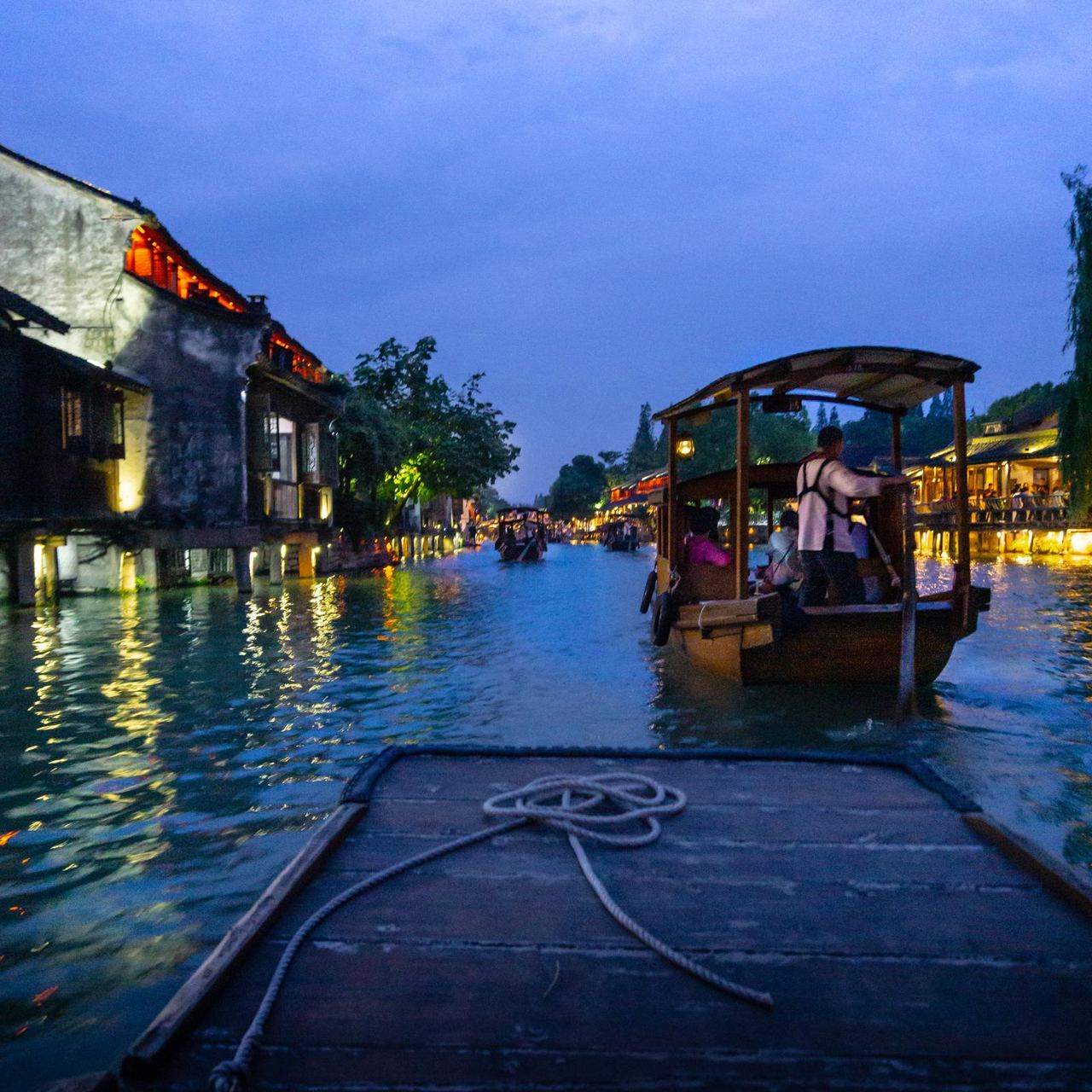
It is also, on the evidence, the most beautiful of them. The restoration is meticulous and the money shows. There are stone waterside terraces and a working indigo-dye yard, with lengths of blue-and-white cloth hung sixteen feet (five meters) high to dry. Add silk workshops, a little water stage where shadow puppetry runs on a schedule, and a night lighting scheme that no unmanaged town can afford. Because entry is ticketed and capacity is controlled, it does not get the raw crush that Zhujiajiao gets on a Sunday.
The trick is that the ticket is a day ticket and the town is an evening town. Stay inside the zone and you have the lanes to yourself after the last bus leaves. That is the whole point, and it is worth the money. Do it as a day trip and you pay ¥150 to see a lovely place at its worst hour. The smaller East Zone shuts in the afternoon, so skip it unless you have the combined ticket and a spare morning.
And three we took out
A round-up that keeps everything is a list, not a recommendation. These three were researched properly and did not make it, and the reasons matter more than the names.
- Zhouzhuang. The most famous water town in China, and the most crowded. The bridges and the Shen and Zhang residences are real, old and worth seeing. But the lanes between them have been given over almost entirely to souvenir shops selling the same stock, and admission runs about ¥50 on weekdays and ¥100 on weekends. Every practical account describes the same experience: waiting in line to cross a bridge. Jinxi is about 5 miles (8km) away, quieter, and cheaper. Go there instead.
- Luzhi. No fault of the town. The streets are free, the 1,500-year-old Baosheng Temple is a serious piece of history, and a ¥45 ticket covers the halls. The problem is that it is reached through Suzhou, not Shanghai: metro to a Suzhou suburb, then a bus. If you are basing yourself in Suzhou for a few days, add it. From Shanghai it costs a Tongli-length journey for a Jinxi-sized town.
- Fengjing. The closest call on the list, and not for the reason we first assumed. Fengjing is reachable by rail. Jinshan North, on the Shanghai–Hangzhou high-speed line, sits about 4 miles (7km) from the old town, and a local bus or a short taxi closes the gap. What kept it off is subject, not access. Entry runs about ¥50 where Zhujiajiao and Qibao are free. The town's real distinction is its farmer-painting village, a genuine folk-art tradition and the thing most people go for, rather than the canals this article is about. Go if the paintings are the draw. If you want a canal day, Zhujiajiao is free and the metro goes there.
Which water town should you pick?
If you have one free afternoon and no appetite for logistics, take line 9 to Qibao and eat. If you have one free day, take line 17 to Zhujiajiao, on a weekday and early. If you have one free day and you want to hear the water rather than the crowd, go to Jinxi and accept the taxi.
If you have a night to spare, spend it in Xitang under the covered walkway or inside the gate at Wuzhen. Both are evening towns being sold to you as day trips. Tongli and Nanxun sit in between: too far to be casual, rich enough to justify the journey, and much better if you stay.
What you should not do is stack two into one day. They are an hour apart on bad roads, and they all look their best at the same two hours. Three canals in ten hours is how a water town becomes a blur of identical bridges.
How do you get there without a tour bus?
Three options cover everything above. The metro reaches two towns outright: line 9 to Qibao, and line 17 from Hongqiao Railway Station to Zhujiajiao. The Zhujiajiao station is about 1.5 miles (2.5km) short of the old town, and a local bus or a very cheap taxi closes the gap. Do not try to walk it in August.
High-speed rail covers the farther towns. Take it to Jiashan South for Xitang (about half an hour), Tongxiang for Wuzhen (about forty-five minutes), Huzhou Nanxun for Nanxun (about 43 minutes, on the line that opened at the end of 2024), and Suzhou for Tongli. In every case there is a bus or taxi on the far end. It is usually cheap, and usually the part nobody warns you about.
Buy rail tickets in advance on holiday weekends, because the trains sell out. The stations are enormous, so give yourself half an hour inside Hongqiao before departure.
A booked car costs far more. It is the right answer only for combining two towns in a day, or for traveling with someone who cannot manage a bus and a station transfer at the far end.
When to go, and three stretches to avoid
The good windows are late March to early May and late September through November. Both are mild and dry-ish, and the canal towns look their best with a bit of low sun on the water. Winter is underrated: cold and gray, but empty, and mist on a canal is not a bad trade.
Now the three windows to plan around. National Day, October 1 to 7, moves an enormous share of the country at once, and the towns near Shanghai take the full weight of it. The Labor Day holiday, around May 1 to 5, is the same thing in miniature. On both, Zhujiajiao and Zhouzhuang become unpleasant. The ticketed towns, Wuzhen and Xitang, hold up better precisely because they cap entry.
Then there is the plum rain. Shanghai's meiyu runs roughly from mid-June to mid-July, on average opening around June 19 and breaking around July 10. That means several weeks of warm, persistent, overcast drizzle, and June is the city's wettest month at around 7 inches (180mm). It is not a reason to cancel, but it does change which town you pick. Xitang's covered walkway makes it a rainy-day town, and an unroofed lane in Jinxi is not.
July and August bring the other problem, which is heat: highs of 90°F (32°C) and up with humidity to match, and nights that barely drop below 79°F (26°C). If you are going in summer, go at eight in the morning and be off the stone by noon.
How PoppaTrip schedules a water-town day
A water town is a day trip, and day trips are the easiest thing to get wrong in an itinerary. People wedge one in beside two city stops and spend the afternoon on a bus. PoppaTrip handles that case explicitly, so here is exactly what it does.
When a curated place is marked as a day trip, the planner gives it a whole day of its own. It looks for a day that is completely empty and not already holding another excursion. On any trip longer than two days it prefers day two onward, because day one is usually an arrival. Once the day trip is placed, the day's stop count is seeded at its full cap, so no ordinary city stop can be dropped in beside it.
The one exception is a day you have explicitly marked as packed. That leaves a single slot open and pushes the clock past the excursion, so a filler lands afterward rather than on top of it.
Weather feeds into the same decision. When the planner has a forecast for your dates, it ranks the candidate empty days by risk and puts the day trip on the driest one. For a town made of open stone lanes that is exactly the right instinct, and it is the bit nobody does by hand. A place counts as a day trip if the curation flagged it as one. On older saved trips it also counts if its estimated duration reads as six hours or more, or says day trip outright.
That is the whole claim. It will not book your high-speed rail ticket and it does not know that the bus from Tongxiang takes fifty minutes. What it does is stop you scheduling Wuzhen and the Bund on the same Tuesday.
If you pick public transport as your transportation preference in the wizard and leave the day-trip flag on for the water town, that is the combination that produces the plans described above.
The mistake almost everyone makes is treating these as one attraction with several branches. They pick the famous one, go on a Saturday, wait in line on a bridge, and conclude that Chinese water towns are overrated. They are not. They are just badly sorted.
Pick by effort and by hour, not by fame. One weekday morning at Zhujiajiao, or one night under the lanterns at Xitang, is worth more than three Saturdays spent shuffling past the same souvenir stall in the most famous town in China.
A closer look at one town
This article sorts the whole group; these posts spend a full day inside one town, or zoom out to the other day trips competing for the same slot.
- Xitang — Xitang Water Town, June 2025 — Beatrice Wong Photography — A first-person day in Xitang with her own photos: the Yanyu Gallery Lane at about 0.8 miles (1.3km) of covered riverfront, a stay at the Xitang Lightyear Hotel near the North Gate, and Shipi Lane, the narrowest street in town.
- Zhouzhuang — Zhouzhuang: The Romantic Water Town Near Shanghai — The Happy Jetlagger — A first-person day in Zhouzhuang with her own photos: the Shuangqiao twin bridges that landed on a 1985 UN postage stamp, a ¥150-per-boat canal ride, and the 100-plus-room Shen House, built in 1742 by descendants of the merchant Shen Wansan.
- Shanghai day trips — Best Day Trips From Shanghai: 6 Easy Escapes by Train or Taxi — Unusual Nomad — The wider menu this article sits inside: Hangzhou, Suzhou, Nanjing, Moganshan and two water towns, each with train time from Shanghai. Updated September 2026; useful if a canal town is only one of the days you are choosing between.
Test your knowledge on Shanghai's water towns
Bridges, gardens, ticket prices — how many can you actually place?