
On this page7 sections
The short answer is to build the day around the heat instead of through it. Go out early, spend late morning through mid-afternoon somewhere cool, and go back out in the evening. Only a handful of cities reach 100°F (38°C) on an ordinary summer afternoon. In Rome, Athens, Tokyo and Shanghai it comes as a heatwave, a few days at a time. Below: which places actually get there, what the forecast number leaves out, and how to build a day with a hole in the middle of it on purpose.
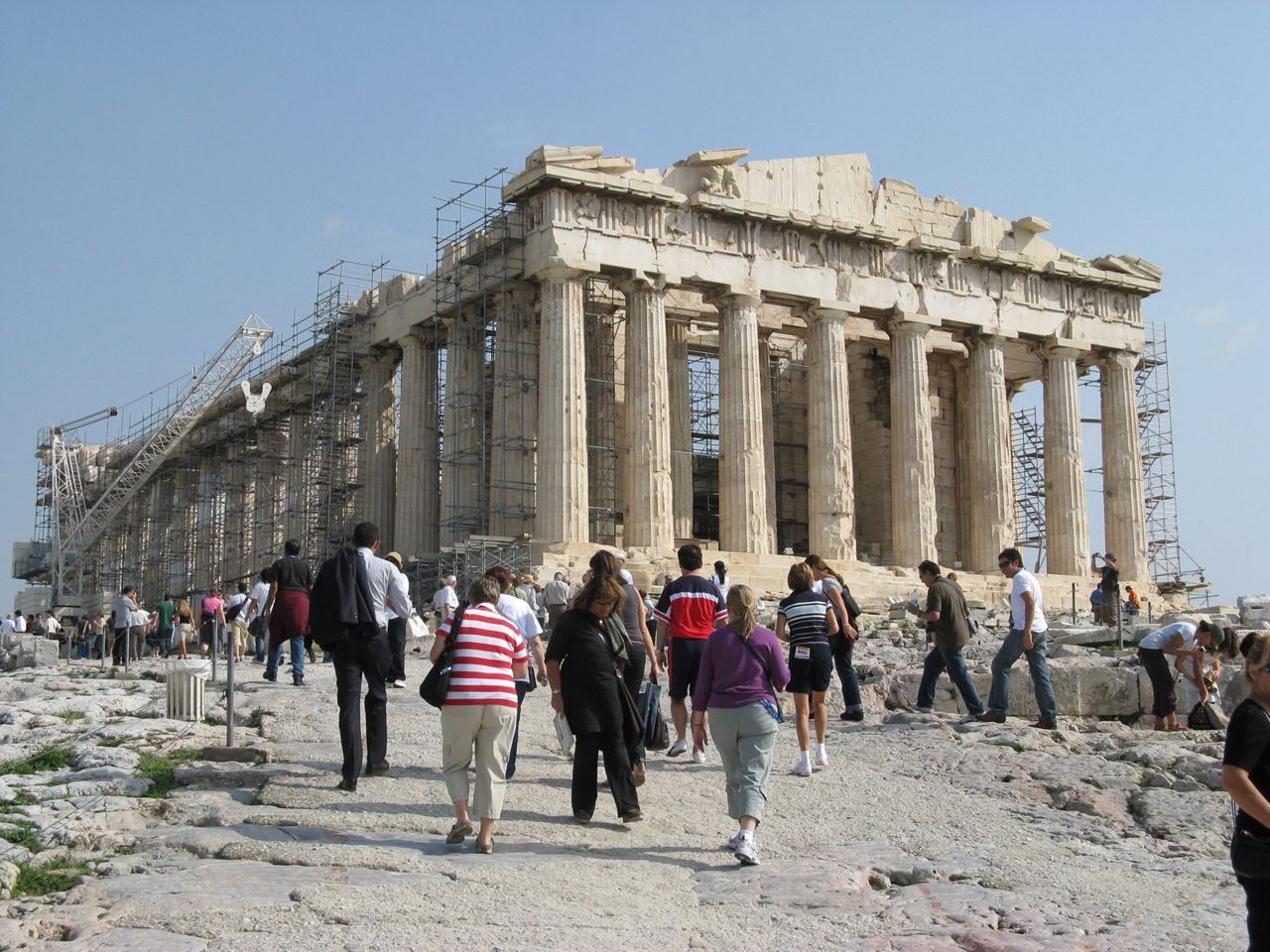
You are on a hill with no trees on it, forty minutes into a line that has not moved, holding a bottle you drank most of an hour ago. The stone underfoot is throwing heat back up at you. Somebody ahead has sat down on the curb in a way that looks less like resting and more like giving up. It is twenty past two. The thing you came for is a hundred yards away behind a gate. You no longer want to see it. You want to be indoors, and you would trade the whole afternoon for a chair in a cold room.
The temperature did the damage, but the itinerary chose the hour. Somebody (you, a blog, a tour operator with a bus to fill) put an unshaded outdoor site in the middle of a July afternoon, and every other decision that day followed from that one.
Heat is also more dangerous than rain. Rain ruins an afternoon. Heat can end a vacation, and sometimes it kills people, disproportionately older ones. So this article sticks to the practical.
One hundred is a day, not a place
Of the cities below, only a handful have ordinary summer afternoons anywhere near 100°F (38°C): Delhi, Dubai, Phoenix, Las Vegas, Marrakesh and, just barely, Seville. In Rome, Athens, Tokyo and Shanghai, 100°F (38°C) arrives as an event on top of the climate, a few days at a time and increasingly often.
That distinction changes the decision. You do not avoid Rome in July on the strength of its average. You go, and keep a plan in your pocket for the three days that spike. Delhi in May is simply a different kind of trip, and pretending otherwise is how people end up in the hospital.
Every figure here is a mean daily maximum for the hottest month, from the national meteorological service, at a named station. The station matters more than it sounds. Athens ranges from 90°F (32.2°C) by the sea to 94°F (34.3°C) downtown, and Sydney's suburbs differ by more than that.
| City | When | What that actually means |
|---|---|---|
| Delhi | April to June | The pre-monsoon build. May averages a daily high of 106°F (41.2°C) at Ayanagar and June is barely cooler; the all-time high is 122°F (49.9°C). |
| Dubai | June to September | August averages 108°F (42.1°C), July 107°F (41.7°C). This is the one place on the list where 100°F (38°C) would count as a mild afternoon. |
| Phoenix | June to September | July averages 107°F (41.4°C). In 2023 the city ran thirty-one consecutive days at or above 110°F (43.3°C), and reached it on fifty-four days in all. |
| Las Vegas | June to September | July averages 105°F (40.3°C) at Harry Reid, with a record of 120°F (48.9°C). The dry air makes it more survivable than Delhi at the same number, not less serious. |
| Marrakesh | June to September | July averages 100°F (37.7°C), so an ordinary July afternoon sits right at the edge of this article. The record is 121°F (49.6°C). |
| Seville | June to September | July averages 97°F (36.3°C) at the airport, and the city holds a 116°F (46.6°C) reading from July 1995. Andalusia is where a European summer stops being rhetorical. |
| Cairo | May to September | July averages 95°F (35.0°C), which surprises people who expect worse. But the record is 118°F (47.8°C), and the heat arrives with no shade to speak of. |
| Athens | June to August | Downtown averages 94°F (34.3°C) in July and August. The metropolitan area held Europe’s official temperature record, 118°F (48.0°C) at Elefsina and Tatoi in July 1977, until 2021. |
| Rome | June to August | August averages 89°F (31.6°C) at Ciampino, with a 109°F (42.9°C) record. The normal Roman summer is hot. In a heatwave it becomes a different city. |
| Istanbul | July to August | The Turkish met service puts the July and August mean daily maximum at 85°F (29.7°C). That is modest on paper, except that almost every line in the city is outdoors in direct sun. The record is 107°F (41.5°C). |
| Shanghai | July to August | July averages 92°F (33.2°C) at Xujiahui with a 106°F (40.9°C) record, and the humidity means the felt temperature runs well above the number. |
| Tokyo | July to September | August averages only 88°F (31.3°C), which undersells it completely. Tokyo’s summer problem is the humidity. |
| Sydney | November to February | Two different cities about thirty miles (50 km) apart. Sydney Airport averages 82°F (27.7°C) in January; Penrith in the western suburbs has hit 120°F (48.9°C). |
| Bangkok | March to May (not the summer vacation months) | The hottest month is April, averaging 96°F (35.7°C), and Bangkok has never officially recorded 100°F (38°C) in July or August. Its problem is humidity on top of highs in the mid-90s°F (mid-30s°C). |
| Ho Chi Minh City | March to May | May peaks at 95°F (34.9°C) on average, and the July and August records sit below 100°F (38°C) entirely. Southeast Asia is not where you go to find a 100°F (38°C) day. |
The companion piece: how to plan a trip around rain →Read the full Tokyo guide →Read the full Shanghai guide →
Why the forecast understates the heat
The heat index, the “feels like” figure, is calculated for shade. Almost nobody is told this, and it is the most useful fact in the article. The US National Weather Service puts the penalty for standing in full sunshine at up to 15°F (around 8°C). So a forecast of 93°F (34°C) feels hotter than that on an unshaded archaeological site, and no amount of stoicism closes the gap.
Humidity does something worse. Sweat only cools you when it evaporates, and humid air will not take it. The same service gives an example: 97°F (36°C) air at 65 percent humidity produces a heat index of 120°F (49°C). That is why Tokyo's modest-looking 88°F (31.3°C) August average misleads, and why Las Vegas's 105°F (40.3°C) is, strangely, more manageable.
Then there is the ground. The Arizona Burn Center measures outdoor surfaces reaching 180°F (82°C) in Phoenix summers, with asphalt running 36 to 54°F (20 to 30°C) hotter than the air. That is hot enough to cause contact burns in seconds. It is a warning about falls, children and dogs. It is also a plain physical fact about the ground you walk on for six hours.
The hottest hours run from late morning to mid-afternoon
Everybody has heard “avoid the midday sun.” Taken literally, it puts people back outside at three in the afternoon, which is worse than noon. Two different things peak at two different times. Ultraviolet peaks at solar noon, when your shadow is shortest. Air temperature peaks later, because the ground keeps absorbing more heat than it sheds for hours after the sun's highest point. The same lag makes August hotter than June, despite June's longer days.
So the dangerous stretch is a band from late morning through mid-afternoon, which is the EPA's own phrasing. Treat it as a block of time that is already spoken for. Not “we'll see how we feel.” Spoken for, in the plan, before you leave the hotel.
How to plan a day in extreme heat
Split the day in two, and mean it
The cities that live with this have already solved it, and their opening hours show the answer. The Alhambra runs a summer timetable in two halves: morning until half past two, then again from five. It also sells a Nasrid Palaces night visit from ten until half past eleven at night, at roughly half the daytime price. Greece goes further. During heatwaves the culture ministry has closed the Acropolis and other sites outright from midday to five, triggered at around 102°F (39°C). It did so in June 2024 and again in July 2025. Two shifts, morning and evening, with a hole in the middle. Build the same shape yourself and the heat costs you almost nothing.
Book the cool hours like an appointment
The World Health Organization asks for more than “stay hydrated.” Its guidance is to spend two to three hours of the day somewhere genuinely cool, alongside about a cup of water an hour. Two to three hours is a museum, a long lunch, a bathhouse, a library, or a movie in a language you do not speak. Choose it in advance and give it the same status as the sightseeing. A body that has not shed its heat load carries it into the evening.
Find out where the water is before you need it
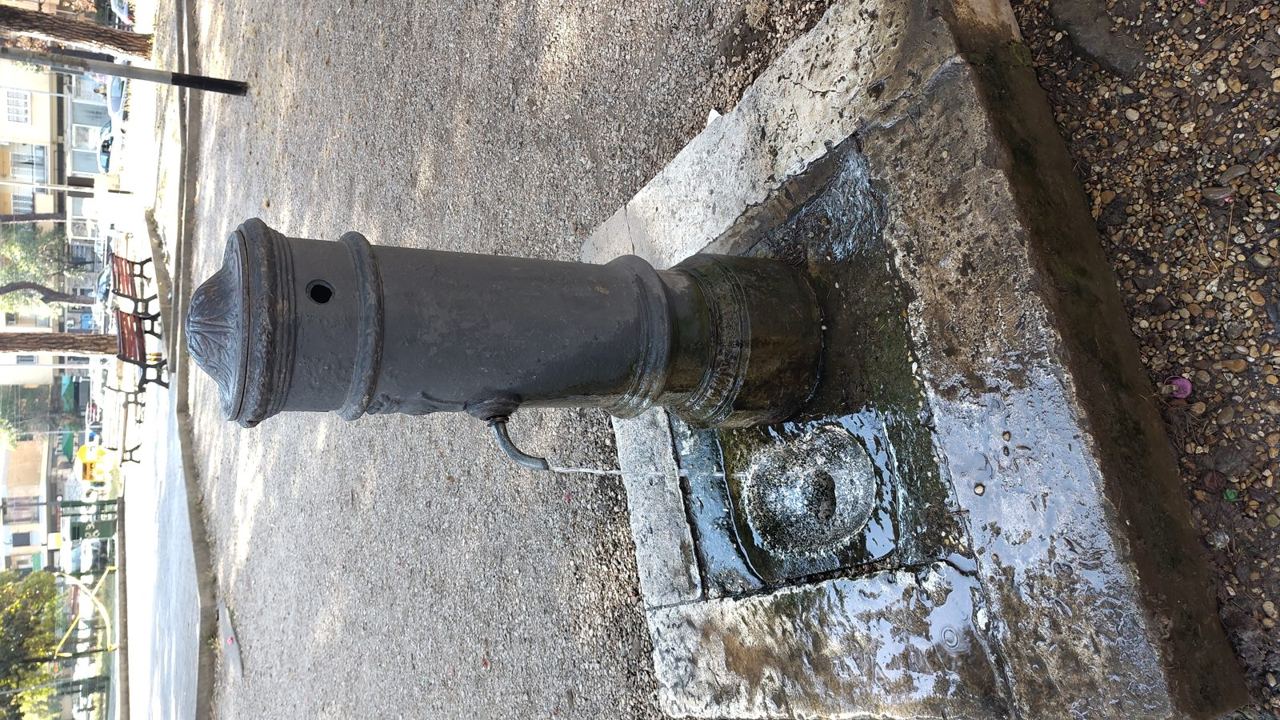
Some cities hand it to you. Rome runs around 2,500 nasoni, the cast-iron street fountains, free and flowing around the clock, with a couple of hundred inside the historic center. Vienna claims 1,600 public drinking fountains, Paris about 1,300 with the locations published as open data, and Zurich more than 1,200. In those cities a bottle and a map solve the problem. Cairo, Delhi, Marrakesh, Bangkok and Ho Chi Minh City are different. There the sensible default is that tap water is not for drinking. Work out where your water will come from on the first morning, before it becomes a problem on the fourth afternoon.
Metro platforms can be hotter than the street
A cooled train does not mean a cool journey. New York's subway platforms run as much as 20°F (11°C) hotter than the street, because the trains' own cooling dumps its heat into the station. Readings around 97°F (36°C) have been recorded down there. London's deep tube lines have no air conditioning at all. Only the shallower Circle, District, Hammersmith & City and Metropolitan lines do, and the first cooled Piccadilly trains are not due until later in 2026. In Paris, lines 3, 8, 10 and 12 have no cooling of any kind. Plan the transfer as well as the route. Five minutes on an open platform at half past three is the part of the day that hurts.
Four pieces of heat advice that are wrong
Heat advice is repeated far more often than it is checked. These four common pieces of it are actively unhelpful.
A fan will help
Only below about 104°F (40°C). Above that, WHO is explicit that an electric fan blowing air hotter than your skin adds heat instead of removing it. In a heatwave, in a room with no air conditioning, a fan is a comfort. It will not cool you down.
95°F (35°C) wet-bulb is the limit of human survivability
This number is everywhere, and it was theoretical. When Penn State researchers put young, healthy people in a heat chamber, none of them reached it. In warm, humid conditions the measured critical value averaged closer to 87°F (30.6°C). The real threshold is lower than the famous one. It is lower again for anyone older or unwell, and they are most of the people heat actually kills.
Just avoid midday
Taken literally, this advice sends people back outside at three in the afternoon, after the ultraviolet peak and straight into the temperature peak. The danger lasts for hours, from late morning to mid-afternoon.
Southeast Asia is where the extreme heat is
Bangkok's hottest month is April, not August, and it has never officially recorded 100°F (38°C) in July or August. Ho Chi Minh City's July and August records sit below 100°F (38°C) entirely. Both cities punish in a different way, with humidity on top of highs in the mid-90s°F (mid-30s°C), which the dry-heat tactics do not fix. Calling them 100°F (38°C) cities is simply wrong.
What PoppaTrip’s planner does about heat
Here is one narrow claim you can check. The wizard asks how you feel about heat, with three answers: hardy, flexible, or avoid it. The planner treats any day whose forecast high reaches 91°F (33°C) as a heat day. The scheduler then weights where things land on that day by the answer you chose. An “avoid it” answer pushes exposed stops away from the hot hours much harder than a “hardy” one does.
That is the whole of it. It does not know that the Alhambra reopens at five, and it will not stop you booking Delhi in May. It does keep your stated preference from being quietly ignored by an itinerary that puts the unshaded hill at two in the afternoon.
Plan a trip that knows about the heat →The companion piece, for the other kind of weather →
The goal is simple: do not spend the best week of your year in line on a hot stone hill at two in the afternoon. You could have seen the same thing at eight in the morning, with nobody in front of you.
The cities that get a lot of heat worked this out generations ago and built their days around it. Copy them.