
historic
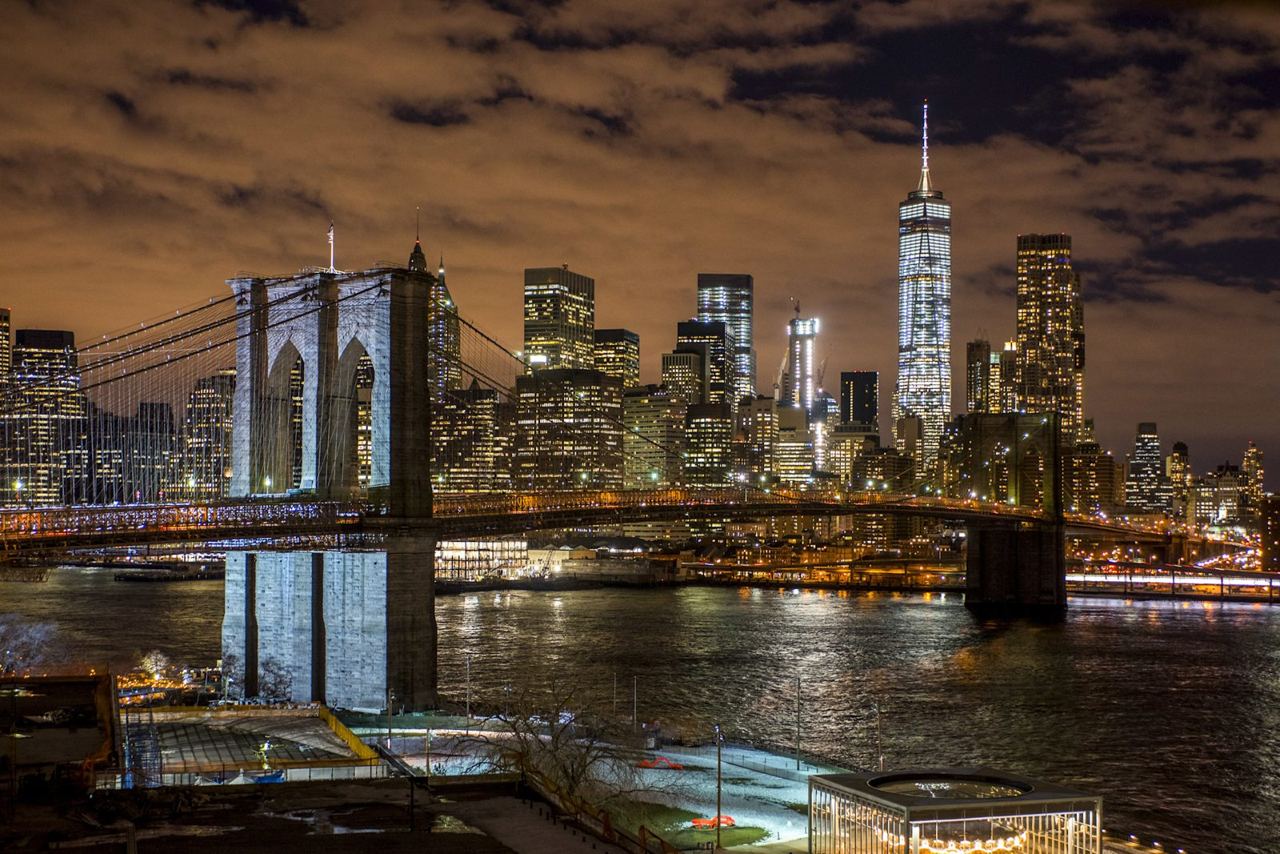
The Brooklyn Bridge
The 1883 granite-and-steel crossing to Brooklyn, with a raised wooden promenade for walkers above the traffic.
Two days is not enough for New York and never will be. It is, however, exactly enough for one downtown day, one midtown day, a walk over the Brooklyn Bridge and a Broadway curtain.
12 places we would actually send someone to, across 5 categories. Photos are in the written guide below, and every photo is of that specific place.
The 1883 granite-and-steel crossing to Brooklyn, with a raised wooden promenade for walkers above the traffic.
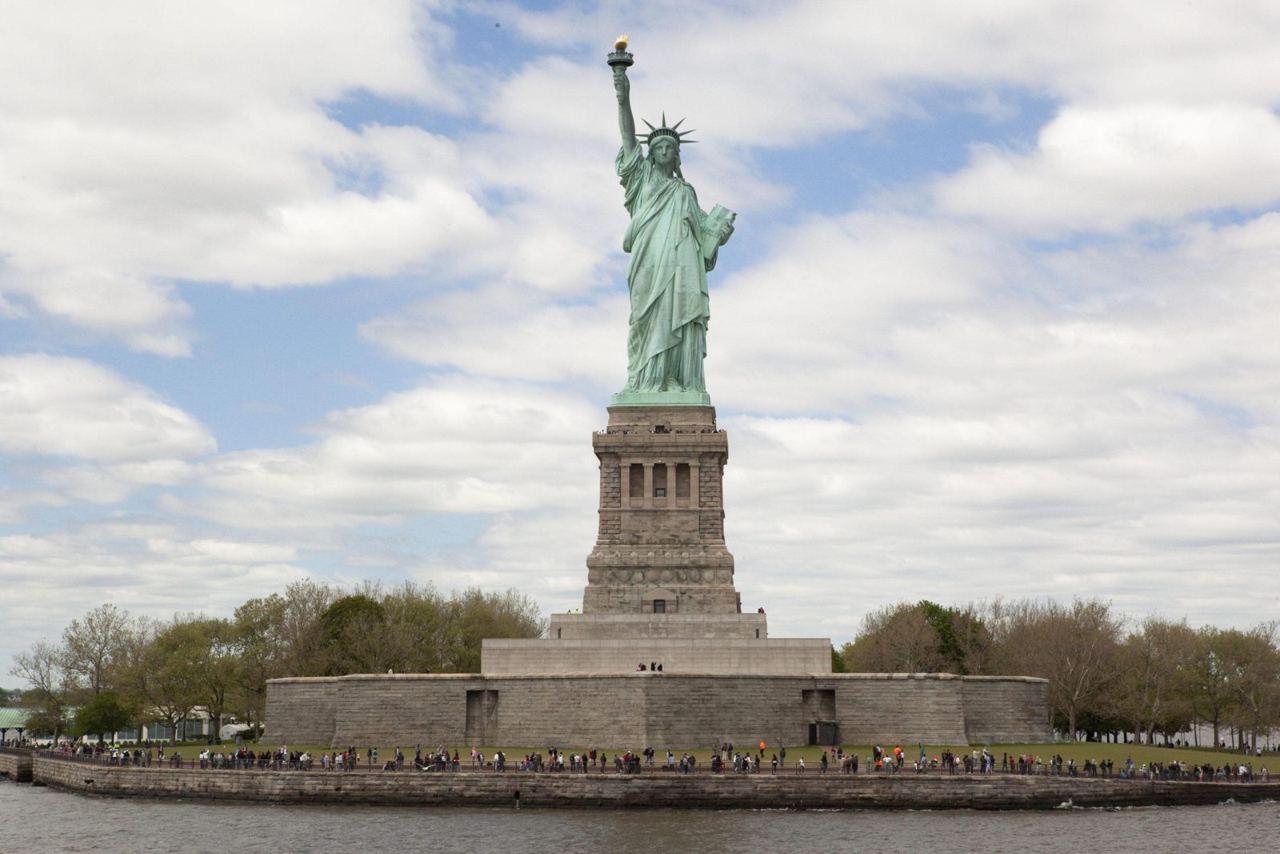
The 1886 statue on Liberty Island and the immigration hall next door, reached by ferry from Battery Park.
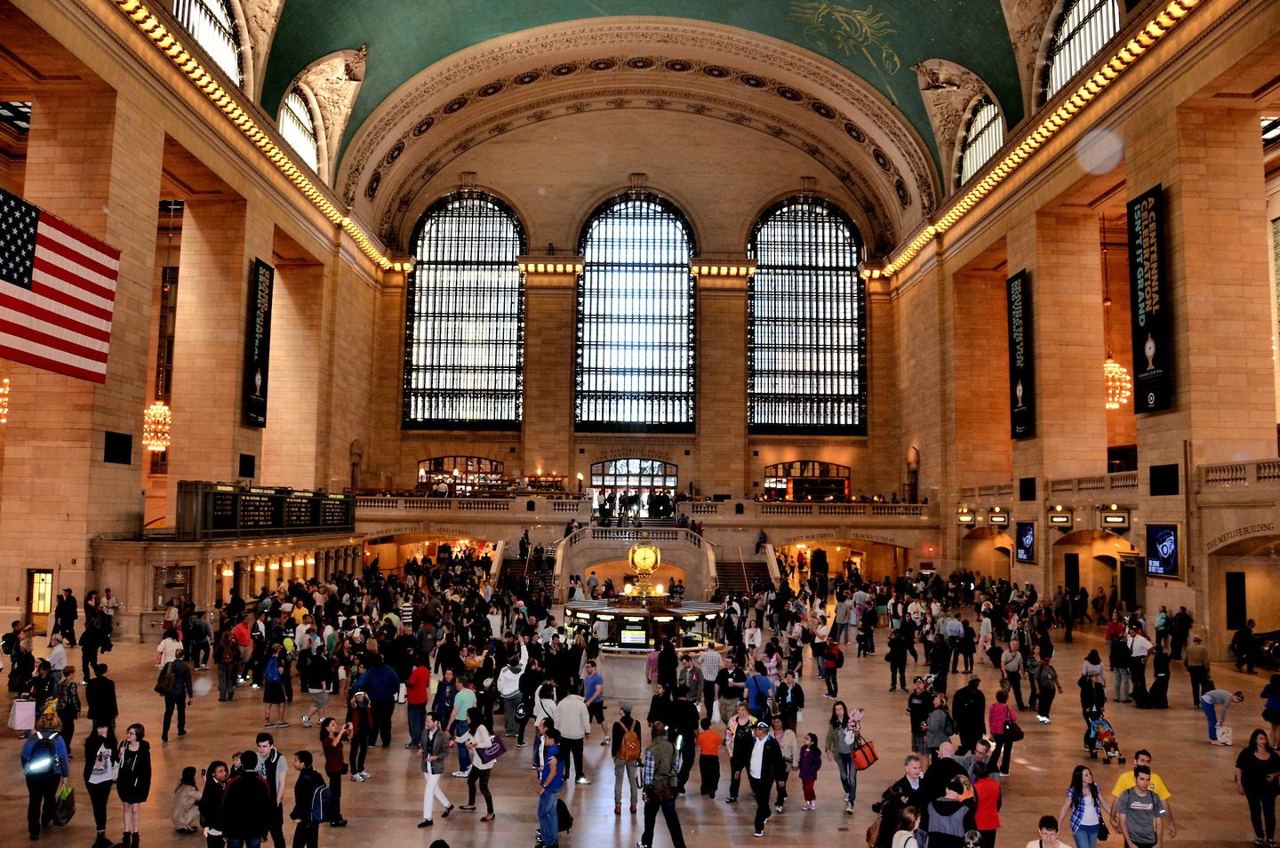
The 1913 Beaux-Arts station whose main concourse ceiling is a painted, gold-on-teal night sky — with the constellations reversed.
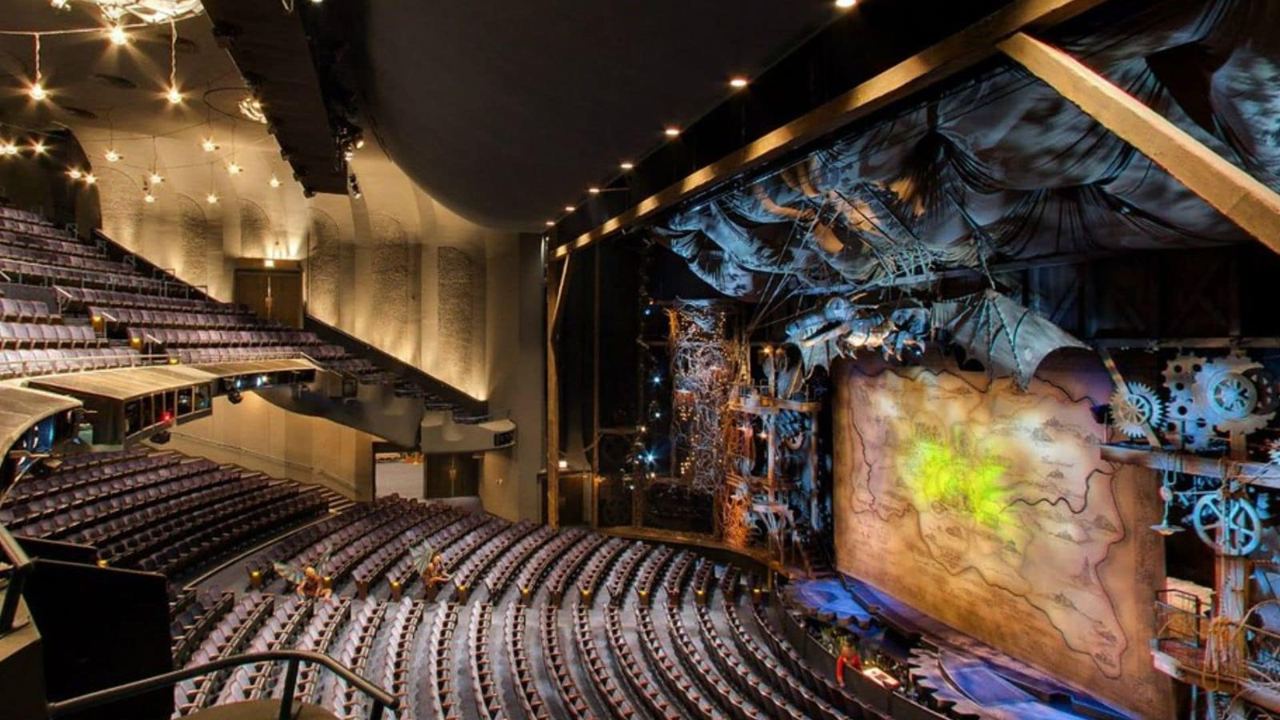
Broadway's fourth-longest-running show, playing the 1,933-seat Gershwin on West 51st since 2003.
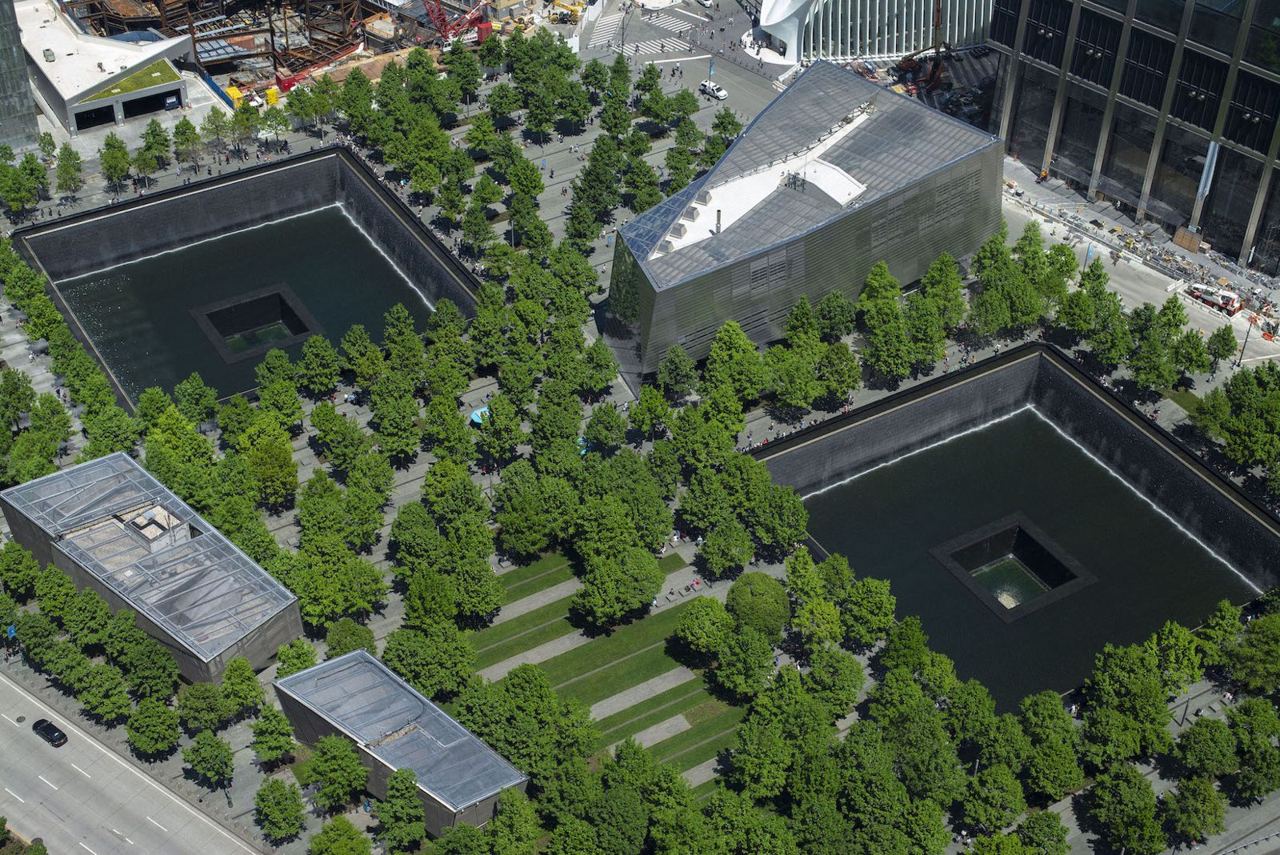
Two sunken pools in the footprints of the towers, names cut into bronze around the edges, and the museum below.
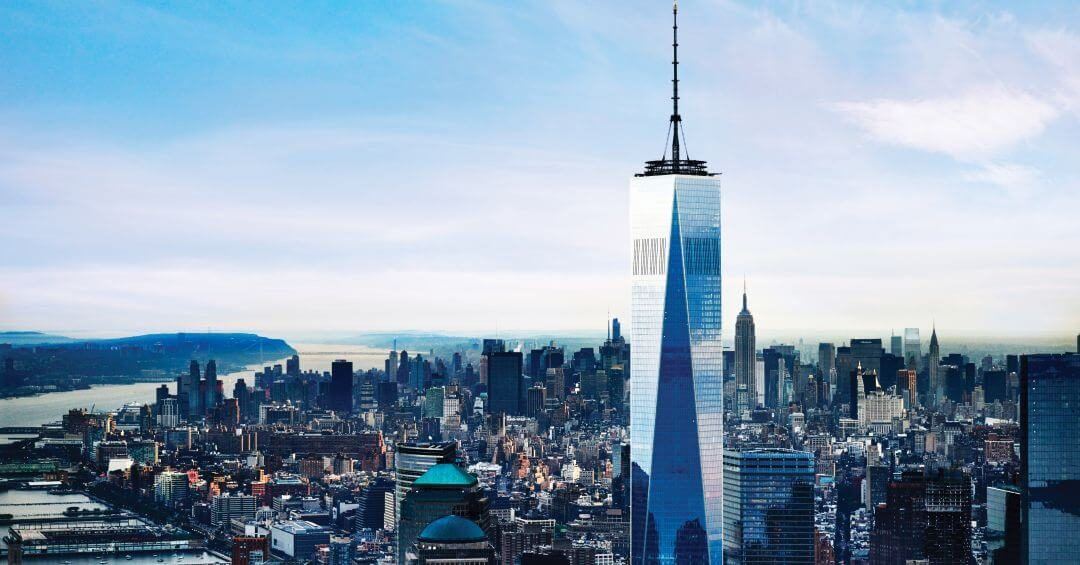
The observation floors near the top of One World Trade Center, 100 stories over the harbor.
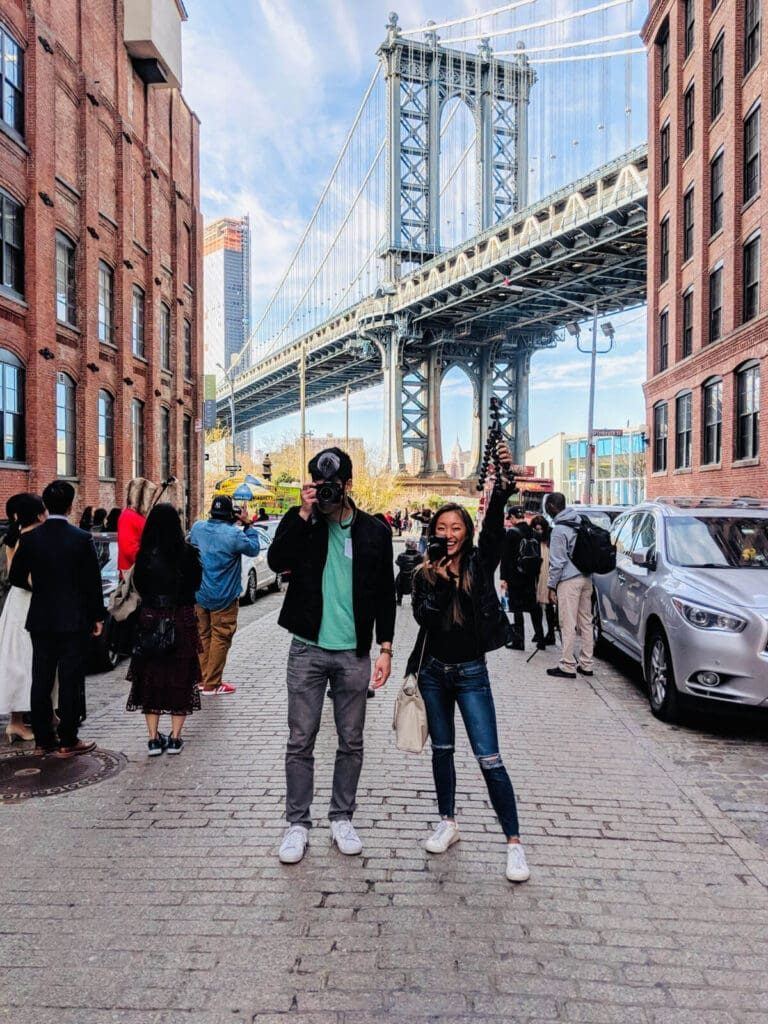
Waterfront park and cobbled warehouse streets under the bridges, facing the whole Manhattan skyline.
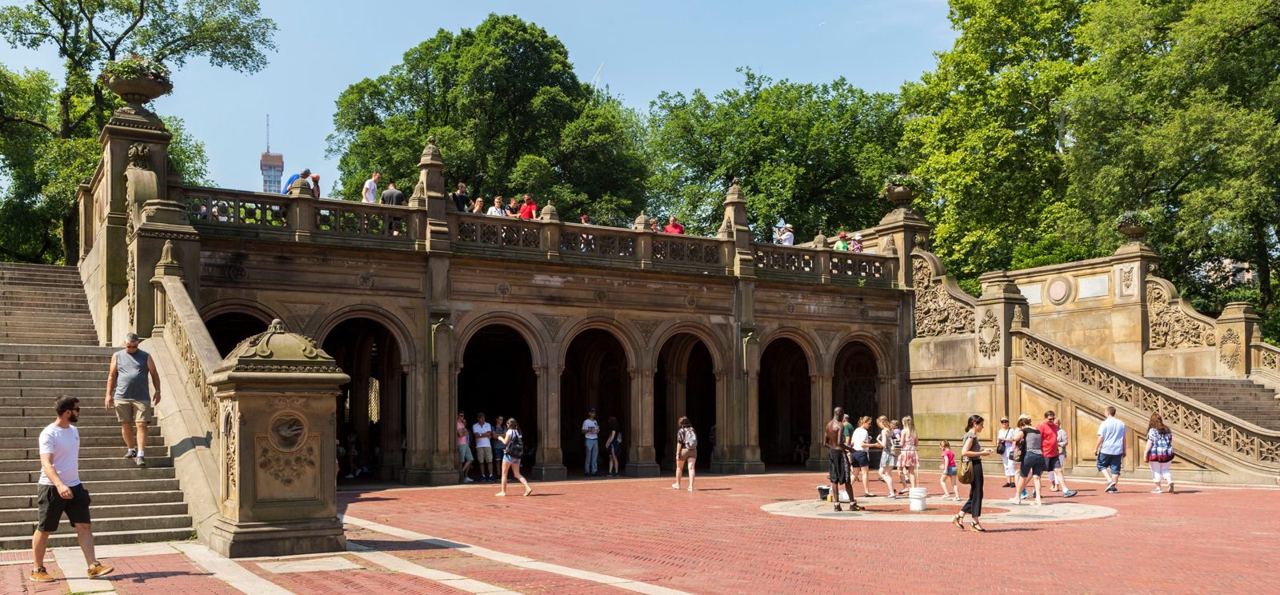
843 acres of designed landscape — the Mall, Bethesda Terrace, the Ramble — dropped into the middle of the grid.
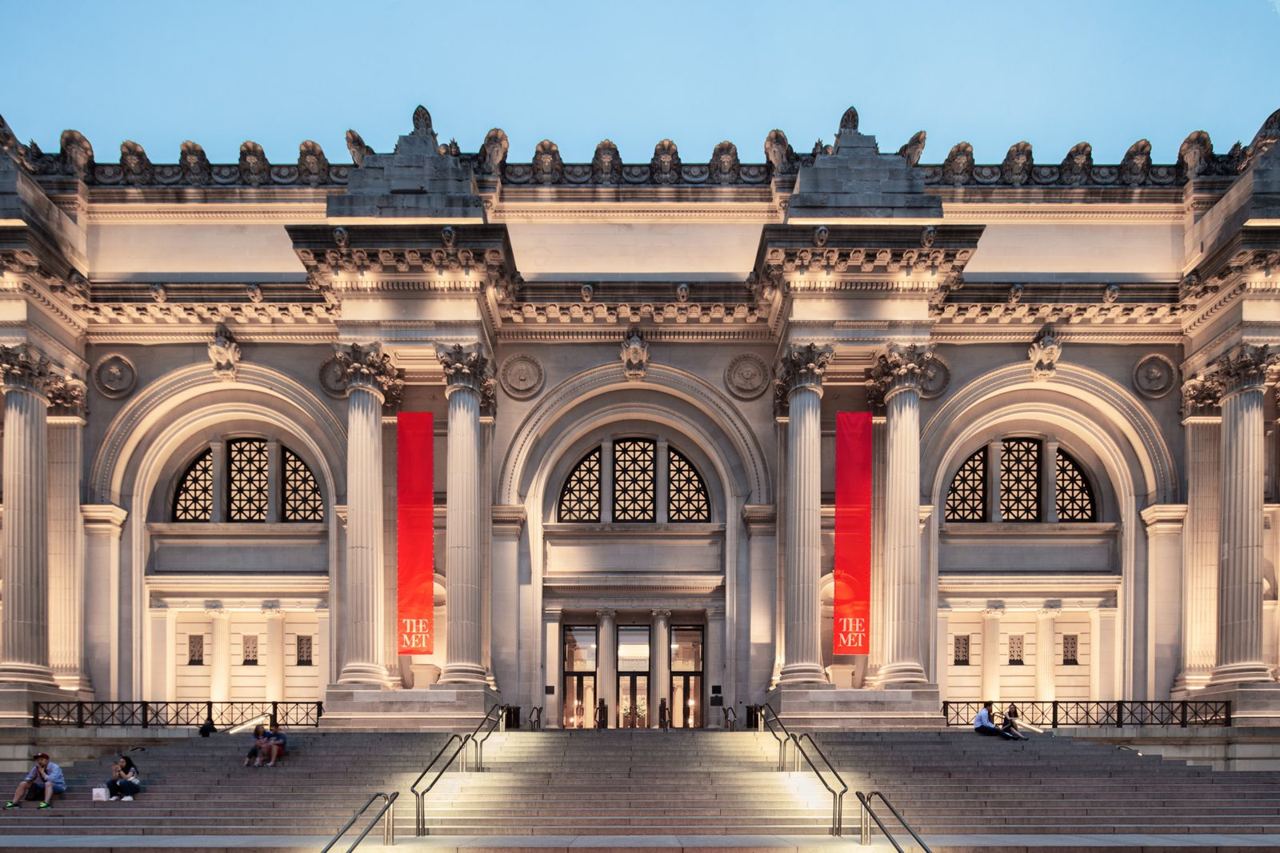
Two million works from five thousand years, on the eastern edge of Central Park.
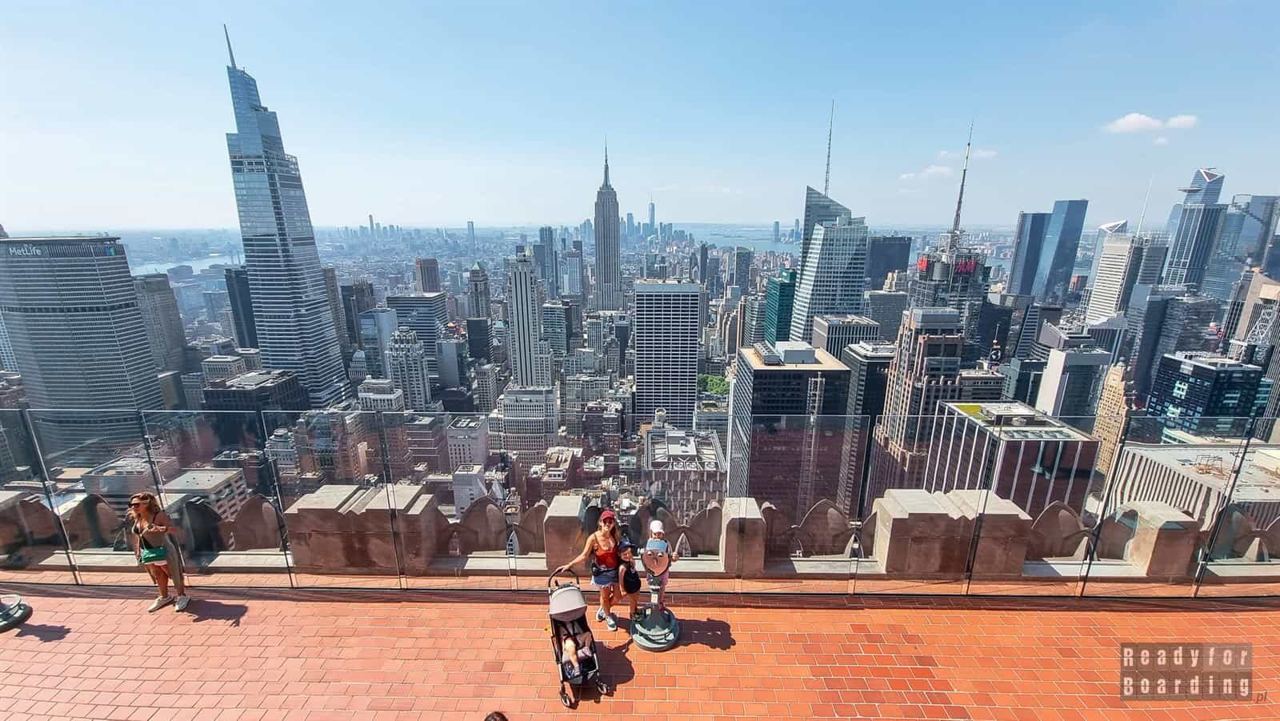
The Rockefeller Center observation decks — the view that has the Empire State Building in it, which the Empire State cannot.
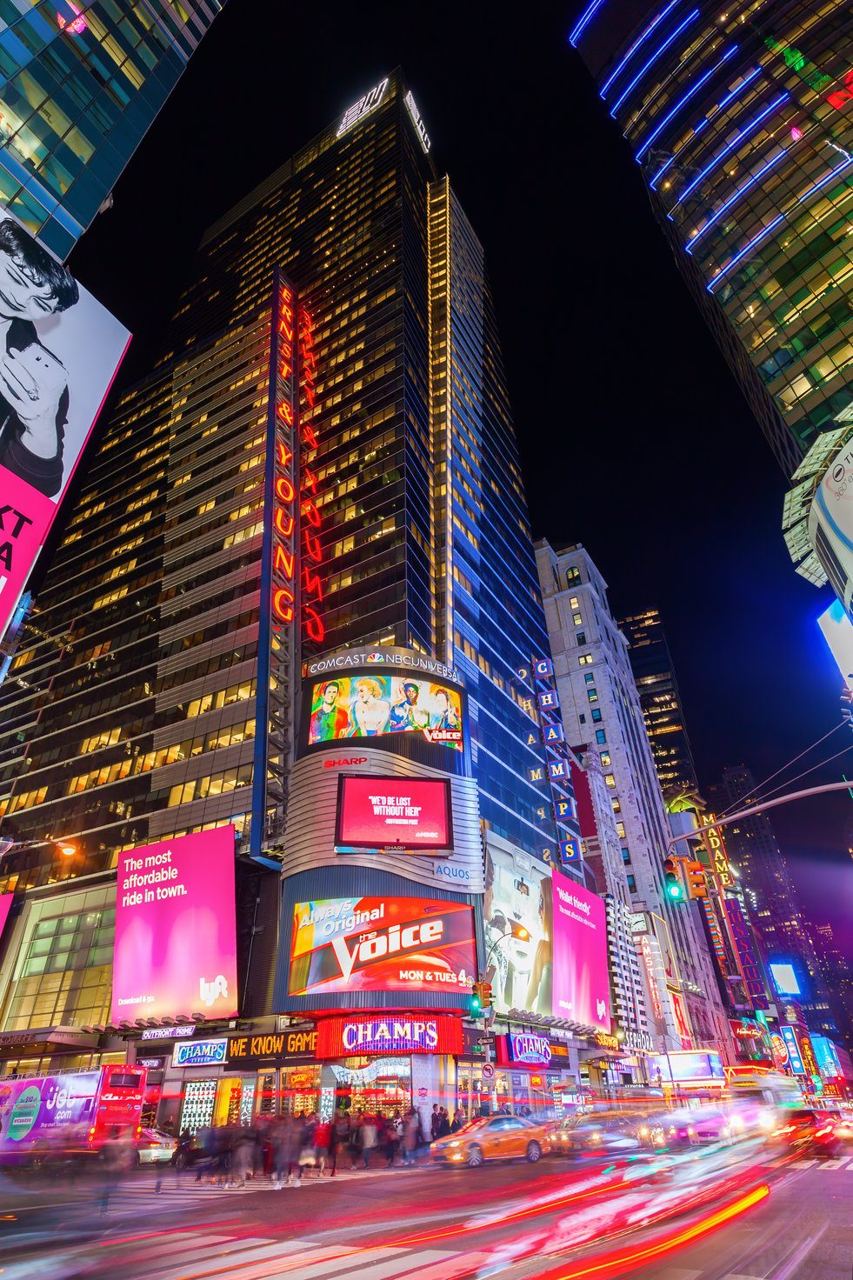
The lit intersection at the heart of the theater district, brightest and busiest after dark.
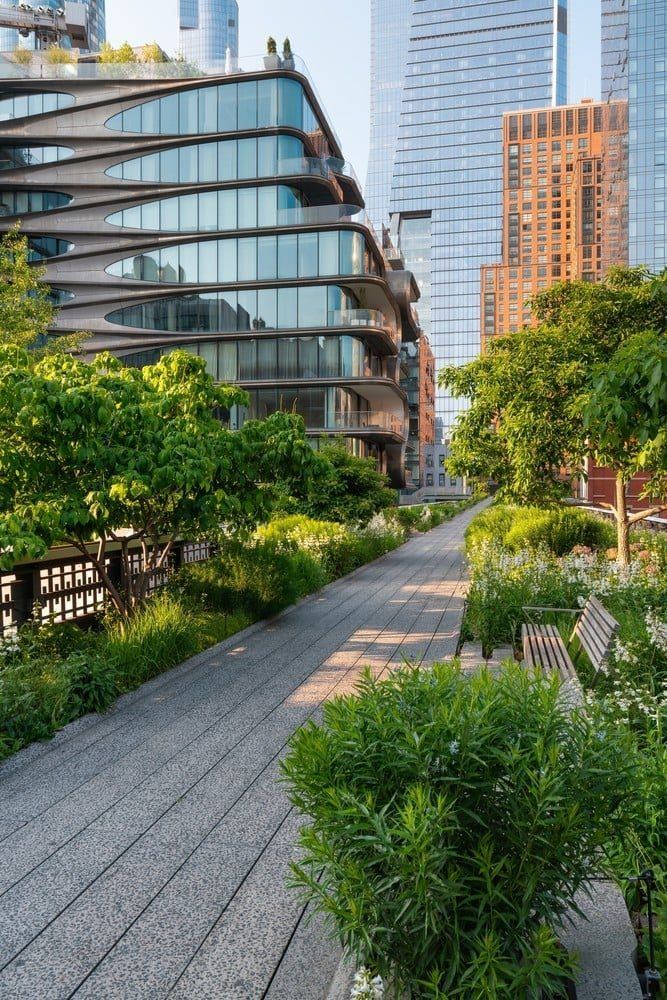
A planted park on a disused elevated freight line, running down to a brick market hall in the old Nabisco factory.
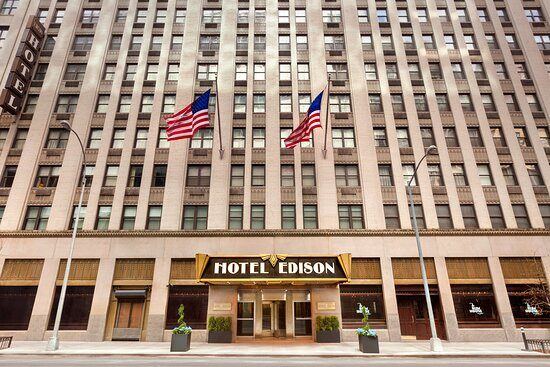 Our base for this trip
For a two-day trip with a Broadway curtain in it, the only sensible place to sleep is the theater district — after the show you walk five minutes rather than working out the subway at eleven at night with two thousand other people doing the same. The Edison opened in 1931, has the Art Deco lobby to prove it, and sits four blocks from the Gershwin, one from Times Square and a short ride from Grand Central. It is not a luxury hotel and it is not pretending to be; what it is is the right address at a price that does not eat the trip. If you would rather trade the walk home for something quieter, the same logic points at Murray Hill or the Financial District — both are one subway line from everything above.
West 47th Street, in the theater district off Times Square
The single decision that makes or breaks a short New York trip is made in the first ten minutes, at the airport, and it is this: you are going to use the subway. Not sometimes. For everything.
A taxi from Midtown to the Financial District at five in the afternoon can take forty-five minutes and cost you a small dinner. The 4 train does it in twelve, for the price of a coffee, and it does not care what the traffic is doing. You tap a credit card or your phone straight on the reader — no ticket machine, no paper — and after a certain number of rides in a week the system stops charging you. There is no cheaper piece of infrastructure in any city on earth relative to what it unlocks.
Two rules and you are fluent. First: uptown and downtown are separate entrances at many stations, and once you are through the turnstile on the wrong side you cannot cross — read the sign on the railing before you tap. Second: the letters and numbers on the front of the train matter more than the color. A 2 and a 3 are both red and they diverge.
So: day one is downtown and Brooklyn. Day two is midtown and the park. Each day is a small cluster you can mostly walk, with the subway carrying you between clusters rather than between every stop. That is what a balanced pace means in a city this dense — not fewer things, less zig-zagging.
Two clusters carry this whole trip, and here is what each venue's own page — or the operator's own line index — says about reaching it, read this session in September 2026. Where a page gives no exit letter, that is recorded as such rather than guessed; where a page would not load at all, that is said plainly too.
Day one lives in the transfer knot at the bottom of the island. Statue City Cruises' own directions send the ferry crowd to Battery Park on the 1 to South Ferry, the 4 or 5 to Bowling Green, or the R or W to Whitehall Street — no exit letter given for any of them, all a short walk from the Castle Clinton terminal. Ten minutes north, the 9/11 Memorial & Museum's own "Getting Here" page lists the A, C, 1, 2 or 3 to Chambers Street, the A, C, J, Z, 2, 3, 4 or 5 to Fulton Street, the 2 or 3 to Park Place, the E to World Trade Center, the R to Rector Street or Cortlandt Street, and the 1 to WTC Cortlandt — again no exit letters. One World Observatory's own page names the same cluster and adds the 4 and 5 to Fulton Street from the east side. From there the day is a walk, not a ride, over the Brooklyn Bridge into DUMBO: Brooklyn Bridge Park's own site says the park is "accessible by several subway lines (A/C, 2/3, 4/5, F, R)" without naming a specific station, so check the operator's map for the exact stop and exit on the Brooklyn side.
Day two turns on the one-stop hop between two stations named for what sits on top of them. Grand Central Terminal is Grand Central-42 St, where the 4, 5 and 6 (Lexington Avenue) and the 7 (Flushing) all stop; the 42nd Street Shuttle exists for exactly one job, the direct run to Times Sq-42 St, which is itself served by the 1, 2, 3, 7, N, Q, R, W and that same S — the MTA's own line-route descriptions, read this session, confirm each of those routings. Between the two stations sit Central Park and the Met, and here the record thins: the MTA's own line index describes the B train as "Central Park West local," consistent with a stop near the 72nd Street entrance this guide uses, but the B line's own stop list would not load this session, so the exact station is not confirmed by name here — check the operator's map. The Metropolitan Museum of Art's own directions page returned a rate-limit error on every attempt this session, and Top of the Rock's and the Gershwin Theatre's own sites returned server errors or gave no subway information at all; none of those three could be verified this session, so none is stated as fact here.
If the trip stretches to a third morning, Chelsea Market's own directions page is specific: the A, C, E or L to 14th Street (Eighth Avenue), then west to Ninth Avenue and 15th Street, no exit letter given. The High Line's southern entrances sit within the same few blocks, but its own site did not load this session, so that connection is stated here, not on the High Line's own authority.
Start at the bottom of the island, at Battery Park, on the first ferry you can get on — the 1 train to South Ferry, the 4 or 5 to Bowling Green, or the R or W to Whitehall Street, all a short walk from the Castle Clinton ferry terminal, per Statue City Cruises' own directions. This is not a preference, it is logistics: the line for the Liberty Island ferry at eleven in the morning is a genuinely dispiriting thing, and at half past eight it is twenty people and a man selling pretzels.
The approach is the part nobody prepares you for. She is not enormous — 46 meters of copper, green with a century and a half of oxidisation — but she is alone on a small island in a big harbor with the wind coming off the Atlantic, and the ferry swings around so you get the profile, and something in your chest does a small unexpected thing. Book the pedestal or crown access weeks ahead if you want to climb; the ground-level walk around the island is free with the ferry and is enough.
Then stay on the boat to Ellis Island, which is the half most people skip and the half that will stay with you. Twelve million people came through that hall. The registry room is vast and tiled and silent, and the museum lets you search the manifests, so if your family came through — and a startling number of American families did — you can find the actual line, in the actual handwriting, with your name on it.
Back at Battery by lunchtime. You are ten minutes' walk from the next thing.
The 9/11 Memorial — a short walk from the Fulton Street or Chambers Street subway cluster (A, C, 1, 2 or 3 to Chambers Street, A, C, J, Z, 2, 3, 4 or 5 to Fulton Street, the E to World Trade Center, the R to Cortlandt Street or Rector Street, the 1 to WTC Cortlandt, per the memorial's own directions page, no exit letters given) — is two square voids set exactly in the footprints of the towers, with water falling down all four sides and disappearing into a second, smaller void in the center that you cannot see the bottom of. The names of every person killed are cut through bronze parapets around the edges, and on someone's birthday the staff place a single white rose in the letters of their name.
It is loud with falling water and completely quiet with people. Give it as long as you need. The museum below ground is extraordinary and heavy — the slurry wall, the last column, the recovered fire truck — and it takes two hours minimum. If you have children with you, or you are simply not up to it today, the plaza alone is a complete experience and nobody will judge you.
Then, if you want the height, One World Observatory is right there — its own page names the same station cluster, plus the 4 and 5 to Fulton Street from the east side — and the elevator is the point: the walls play a time-lapse of the city rising around you across four hundred years in forty-seven seconds. From the top you can see the whole harbor, the ferry you were on this morning, and the bridge you are about to walk.
This is the best hour of the two days, and it is free.
The Brooklyn Bridge has a wooden promenade raised above the traffic, which means you walk over the cars, in the middle, through the cables. It is about 1.8 kilometers and takes half an hour if you do not stop, and you will stop. Go west to east — Manhattan to Brooklyn — because that way the skyline is behind you and every time you turn around it has rearranged itself, and by the time you reach the Brooklyn side the sun is going down behind it.
When it opened in 1883 it was the longest suspension bridge in the world by half. Its designer died of tetanus from an injury surveying the site; his son took over and got the bends so badly he directed the rest of the construction from a window with a telescope; his wife Emily learned the engineering and effectively ran the project for a decade. Then, days after it opened, a rumor that it was collapsing caused a stampede that killed twelve people, and the following year P. T. Barnum walked twenty-one elephants across it to prove it was sound.
You come down into DUMBO — the cobbled warehouse streets under the two bridges — and the whole of Brooklyn Bridge Park is in front of you along the water, with the entire Manhattan skyline switching on across the river. Eat here. Sit on the grass for a while. Then take the A or C back from High Street in about fifteen minutes, which after a day like that feels like cheating.
Most cities have a train station. New York has a room.
The main concourse at Grand Central is 84 meters long and 38 meters high, and the ceiling is a deep gold-on-teal night sky with the zodiac painted across it and 2,500 stars, sixty of them lit. Stand under it in the morning while the light comes down in hard columns through the arched windows and the commuters cut across in every direction, and it is one of the great free spectacles anywhere.
Two details worth having. The constellations are backwards — painted, depending on who you believe, from a medieval manuscript that showed the sky as God would see it from outside, or by someone who simply made a mistake nobody wanted to admit. And in the corner by the Oyster Bar there is a low vaulted arcade where, if you stand facing into one corner and whisper, a person in the diagonally opposite corner twelve meters away hears you perfectly. Everyone tries it. It works.
This is also where you make the day work: Grand Central-42 St is a hub for the 4, 5 and 6 (Lexington Avenue) and the 7 (Flushing), plus the S Shuttle, so you can get almost anywhere from here in one ride — including the one-stop shuttle straight to Times Square, which is where the day ends up.
Central Park is not a gap left over between buildings. Every hill, lake and rock outcrop in it was designed and built in the 1850s and 60s, on land that was swamp and shanties, by thousands of workers moving more earth than the Suez Canal. It is four kilometers long and it is fake in the most magnificent way.
Do not try to see it. Take one line through it: in at 72nd Street, down the Mall under the elms, out onto Bethesda Terrace with the angel on the fountain and the arcade underneath tiled in ten thousand encaustic tiles, then up around the lake to the Ramble, which is thirteen hectares of deliberately confusing woodland paths where people go to get lost on purpose and birders go in May.
Come out on the east side and the Met is right there. Two million objects; you have ninety minutes. So pick two things and let the rest go — the Temple of Dendur in its glass hall with the reflecting pool, and one gallery you actually care about. Trying to do the Met properly in an afternoon is how you end up remembering a corridor.
Go up Top of the Rock rather than the Empire State, for one simple reason: from up here the Empire State Building is in your photograph, and from the Empire State it cannot be. You also get Central Park laid out whole to the north, which is the view that actually explains the city — a green rectangle with a wall of towers around every edge.
Then down into Times Square — Times Sq-42 St itself, where the 1, 2, 3, 7, N, Q, R and W surface alongside the S Shuttle from Grand Central — which you should do once, at night, at speed. It is loud and commercial and there are people dressed as cartoon characters who will want money for a photograph, and it is also genuinely astonishing: eight stories of moving light on every side, bright enough to read by at midnight. Ten minutes is the correct dose. Take the photograph, do not buy anything, and walk two blocks west, where the actual reason you are here is waiting.
The Gershwin is Broadway's largest theater, 1,933 seats on West 51st, and Wicked has been playing in it since 2003 — long enough that people who saw it as children now bring their own. It is the story of Oz from the witch's side: how a clever, green, unpopular girl becomes the villain of somebody else's story, and what her friendship with the blonde one costs them both.
It is worth saying why this show in particular survives, because it is not nostalgia. The score does something structurally clever — songs return in different mouths and different keys as the meaning of the story inverts — and the second act quietly rearranges every scene you watched in the first. Also, at the end of act one, a woman goes up into the air on a note held long enough that the audience starts making noise before it lands. The whole room does it. You will do it too.
Practical things: the curtain is 7pm or 8pm depending on the day, matinees run Wednesday and Saturday, and the theater asks people to be seated well before. Book ahead — this is the one item in these two days you cannot improvise. Afterwards you come out onto West 51st with a couple of thousand other people at the same moment, and the street is bright and mild and everyone is talking at once, and if your hotel is in the theater district you simply walk home.
If the trip stretches, spend it on the High Line. A freight railway ran on an elevated steel viaduct through the west side warehouses until 1980, then sat abandoned for twenty years growing wild grass while the city planned to demolish it. Two neighbors campaigned to keep it. It is now a planted park two and a half kilometers long, nine meters up, running between and occasionally straight through buildings.
The planting deliberately echoes the weeds that colonized the tracks, the old rails surface through the paving in places, and there is a sunken amphitheater with a glass wall where you sit and watch the traffic on Tenth Avenue like it is television. It ends at Chelsea Market, a brick hall in the old Nabisco factory where the Oreo was invented, now forty-odd food counters. Eat lunch there — the A, C, E or L to 14th Street (Eighth Avenue) is the same stop that gets you to the market itself, per Chelsea Market's own directions — then get the subway to the airport.
Entirely by subway. Tap a credit card or phone straight on the reader; after enough rides in one week the fares stop. It beats a taxi on both time and money at almost every hour.
Day one downtown and Brooklyn — Statue of Liberty first thing, the 9/11 Memorial at midday, then walk the Brooklyn Bridge at sunset. Day two midtown — Grand Central, Central Park and the Met, Top of the Rock at dusk, a Broadway show at night.
Late afternoon, walking west to east from Manhattan to Brooklyn, so the skyline is behind you and lights up as you arrive in DUMBO. It is about 1.8km and takes 30–40 minutes with stops.
The Gershwin Theatre on West 51st Street, Broadway’s largest at 1,933 seats. It has run there since 2003, with matinees on Wednesday and Saturday. Book ahead — it is the one thing in this plan you cannot improvise.
Yes, on the first ferry of the day from Battery Park. Stay aboard for Ellis Island, where you can search the immigration manifests by name — that half is the one people remember.
The painted night-sky ceiling (the constellations are reversed) and the whispering gallery outside the Oyster Bar, where a whisper into one corner is heard clearly in the opposite one.
The theater district, so you can walk home after the show. Murray Hill or the Financial District work too — both are one subway line from everything in this plan.
People willing to commit to the subway for everything, since that single decision is what makes a short trip here work. It suits a clustered, walkable pace within each day — downtown and Brooklyn on one, midtown and the park on the other — rather than zig-zagging between famous names. And it suits culture and city energy in the same trip: the Met and Grand Central's painted ceiling on one end, Times Square at full volume on the other.
Tell PoppaTrip your travel style in the wizard and we'll build a day-by-day itinerary with hotels, routing, and booking links. Answering the wizard and previewing your destination is free; building and unlocking your complete trip is a one-time $9.99.
Yes — every photo is a real photo of that specific place, never a stock image.
Two days in New York only works if the days are clustered and the subway does the moving — the order is the whole plan.
Prices/photos from our trip-planning engine.
Rain rarely ruins a trip on its own. A badly ordered day does, and rain is what exposes it. Here is which cities are wet and when, and how to build days that survive it.
Read the article →Seasons are too blunt to book with. Here is the week to buy and the week that quietly costs double in ten cities: the value windows, the trap weeks that look like shoulder season, and the 2027 holiday dates that move them.
Read the article →The same $50 is more than enough in Hanoi and doesn’t cover a day in New York. Here is what $50, $100 and $200 a day actually buys in twelve cities: meals, local transit, one attraction entry and a coffee. The hotel and flights are counted separately.
Read the article →The factories below still let travelers onto the floor, from the MINI plant in Oxford to the Airbus line in Toulouse, while several famous ones have quietly stopped letting visitors in. A factory tour is rare in travel because the place is not there for you. The line runs whether you come or not, so the tours that remain impose rules no museum would dare: no camera, no backpack, passport at the gate, nobody under eleven. Here is what each one costs, what you actually see, and who gets turned away.
Read the article →